CATEGORIES
TAGS
How to listen to podcasts completely ad-free
TL;DR:
- Many listeners skip 20-45% of ads, which impacts creator earnings and diminishes immersion.
- Ad-free podcast options include AI blockers, platform subscriptions, and public media memberships, each with pros and cons.
- Supporting creators directly or using ad-blockers involves tradeoffs, but personalized strategies can optimize the listening experience.
You’re deep into a fascinating episode. A guest just dropped the kind of insight that makes you pause everything. Then it happens. An ad rolls in, and suddenly you’re hearing about a mattress company for the third time this week. That frustration is real, and you’re not alone in feeling it. The good news? Millions of listeners are already solving this problem, and the tools to get there are better than ever. Here’s everything you need to know about going fully ad-free.
Table of Contents
- Why ad-free podcast listening matters
- Overview of ad-free podcast options
- Comparing ad-blocking apps vs. subscriptions vs. donation models
- Putting ad-free podcasting into action: Practical tips for 2026
- What most guides miss about ad-free podcasting
- Discover more with Prodcast
- Frequently asked questions
Key Takeaways
| Point | Details |
|---|---|
| AI removes podcast ads | Apps like Herd and ZeroAds can skip more than 90% of ads automatically. |
| Subscriptions support creators | Paying for ad-free feeds helps fund the podcasts you love directly. |
| Hybrid approaches work best | Mixing AI blockers and paid feeds gives you seamless, interruption-free listening. |
| Time savings add up | Switching to ad-free tools can reclaim hours of listening each year. |
Why ad-free podcast listening matters
Let’s start with the numbers, because they tell a clear story.
Podcast listeners skip 20-45% of dynamic ads when playback controls are available. Host-read ads do hold attention slightly better, reducing skipping by 10-25%, but even those can feel intrusive when you’re locked in on a great conversation. And the market is responding. Ad-free subscriptions are projected to hit 15% of total podcast listeners by 2025, which signals a real cultural shift in how people want to consume audio content.
Think about what that means for your weekly listening. If you tune in for five hours a week, you could be sitting through 45 to 60 minutes of ads every single month. That adds up fast.
“The single biggest reason listeners cite for abandoning an episode is repetitive advertising that interrupts the flow of a compelling story or interview.” — A recurring theme in data-driven insights on podcast ads
The impact goes beyond just time. When you’re listening to a trusted creator talk about a product they genuinely love, that moment lands differently than a scripted slot. Ad-free listening actually sharpens your ability to catch those organic recommendations, the ones that matter. You stay tuned to the good stuff without being pulled out of the moment.
Here’s what listeners typically gain by going ad-free:
- More time back. Skipping ads can cut your total listening time by 10-20% per episode.
- Better recall. Without ad clutter, the actual insights and product mentions from creators stick more.
- Deeper immersion. Fewer interruptions means longer focus sessions, which matters if you’re learning or working while you listen.
- More discovery. You can cover more shows and topics in the same amount of time.
Not all ad types are equal, though. Dynamic ads are inserted into the audio file programmatically and are much easier to detect and skip. Host-read ads, where the creator personally reads the sponsor message in their own voice, are woven into the episode itself. Both are solvable, but with different tools.
Now that you’re aware of just how much time and attention ads can take up, let’s explore the landscape of ad-free solutions.
Overview of ad-free podcast options
Three main approaches dominate the ad-free landscape right now: AI-powered ad blocker apps, premium platform subscriptions, and public media membership models. Each one has its own strengths, and the right choice depends on what you listen to and how much you want to spend.
AI-powered ad blocker apps like Herd, Earsay, and ZeroAds are probably the most exciting development in this space. These apps automatically detect and skip host-read, dynamic, and inserted ads using audio analysis or transcription comparison, achieving 90%+ removal rates on most episodes. That’s a genuinely impressive result. They work across almost any podcast without requiring a direct relationship with the creator.
Platform subscriptions like Apple Podcasts Subscriptions work differently. Creators set their own pricing at around $2.99 to $4.99 per month per show, and subscribers get an ad-free RSS feed along with perks like bonus episodes and early access. It’s clean, it’s reliable, and it directly supports the creators you love.
Public media memberships such as NPR+ offer another path. NPR+ and similar public media memberships offer sponsor-free listening for $10 or more per month, covering 25 or more shows with full archives included. If your playlist leans heavily on journalism and public radio content, this model is a great fit. You’re also supporting institutions that rely on listener funding.
There’s also the role AI tools for podcasting are playing more broadly, from content analysis to ad detection, which shows just how quickly technology is reshaping this space.
Here’s a quick comparison of your main options:
| Platform | Monthly cost | Ad removal type | Creator support | Bonus content |
|---|---|---|---|---|
| Herd / ZeroAds (AI apps) | Free to $4.99 | Dynamic + host-read | Indirect | No |
| Apple Podcasts Subscriptions | $2.99 to $4.99 per show | Full feed ad-free | Direct | Yes |
| Spotify Premium | $10.99 | Platform ads only | Partial | No |
| NPR+ | $10+ | Sponsor-free episodes | Direct | Archive access |
| Patreon/Creator direct | Varies | Full ad-free feed | Direct | Often yes |
With the landscape set, it’s time to break down the strengths and weaknesses of each approach.
Comparing ad-blocking apps vs. subscriptions vs. donation models
This is where your personal listening habits really matter. Let’s get specific.
AI ad blockers are the most flexible option. You can apply them across any show, on any platform, without committing to individual subscriptions. The catch? Ads fund 60-85% of podcast shows, and ad-free tools like ZeroAds and PodSkip enable listening but reduce creator earnings. That’s a real tradeoff. If you use an AI blocker on a small independent show, the creator genuinely feels the impact.
Spotify Premium is the most popular subscription in podcasting, but it’s worth knowing what you’re actually getting. Spotify Premium removes platform-inserted ads from music but not host-read or dynamic podcast ads, which are creator-controlled. The result? Premium users still hear around 71% of podcast ads on average. That’s a surprise for a lot of people who assume Premium means fully ad-free.
You can dig deeper into podcast ad effectiveness to understand why certain ad formats stick even when listeners try to avoid them, and why host-read formats are increasingly dominant across platforms. For a closer look at platform-specific trends, Spotify podcast ads trends covers the data in detail.
Direct subscriptions through Apple or Patreon offer the cleanest guarantee. You pay the creator directly or through the platform, and in return, you get a feed with no ads whatsoever. The downside is cost accumulation. If you follow 10 shows and each charges $4 per month, that’s $40 a month just for podcasts.
NPR+ and public media memberships sit in a comfortable middle ground. They cost more as a single payment but cover a wide range of shows under one roof, and you’re explicitly supporting the production of the content you love.
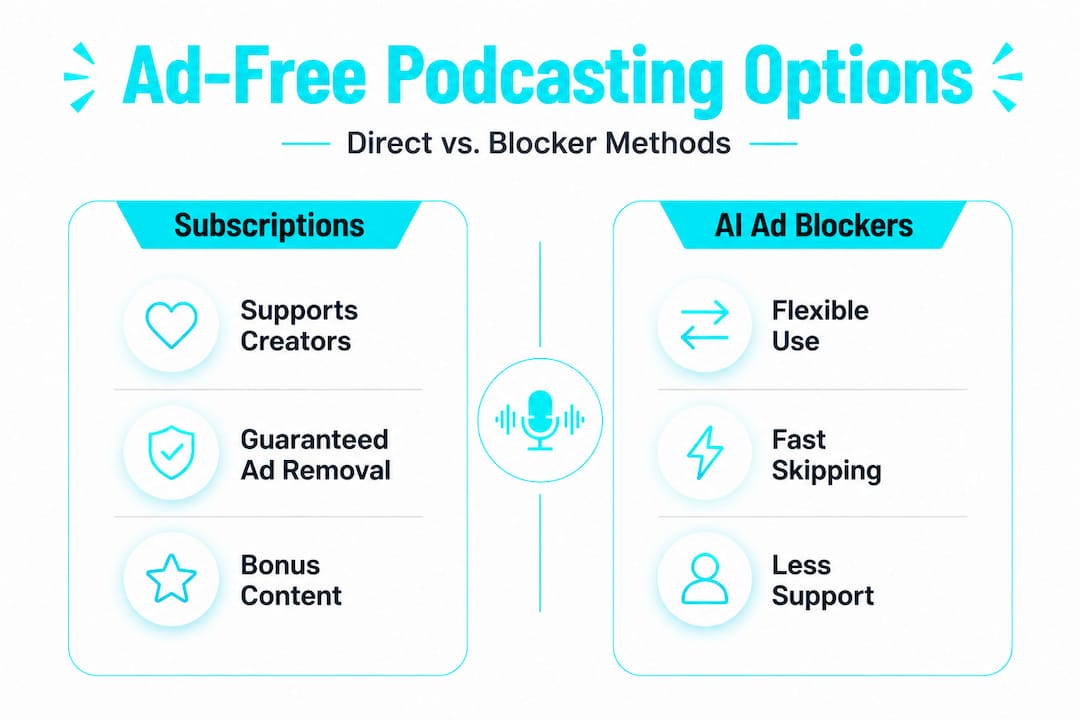
Pro Tip: Mix methods to get the best of everything. Use a free or low-cost AI blocker for general shows and casual listening, and reserve direct subscriptions for the two or three creators whose work you absolutely love and want to support financially.
Here’s a practical breakdown of steps to set up each method:
- AI blocker apps: Download Herd or ZeroAds, import your RSS feeds or connect your existing podcast app, and enable automatic ad detection in settings.
- Apple Podcasts Subscriptions: Open Apple Podcasts, search for your favorite show, tap “Subscribe” on the channel page, and select the subscription tier that includes ad-free listening.
- Spotify Premium: Upgrade through the Spotify app or website, note that this only removes Spotify-inserted ads, not creator-read ones.
- NPR+: Visit the NPR website or your local public radio station’s site, select a membership tier, and link your NPR account to activate ad-free listening in the NPR app.
- Patreon/Direct: Visit the creator’s Patreon page, select a support tier that mentions ad-free RSS access, and add the private feed URL to your preferred podcast app.
Once you’ve analyzed the tradeoffs, you can put these solutions into action for a seamless, uninterrupted listening experience.
Putting ad-free podcasting into action: Practical tips for 2026
Ready to actually make the switch? Here’s how to approach it without overcomplicating things.
Start by auditing your current playlist. How many shows do you listen to regularly? Which ones are heavy on ads? Which ones do you care most about? That inventory shapes your entire strategy. If your top three shows are on Apple Podcasts and all offer subscriptions, that might be your primary move.
AI apps can cut episodes 10-20% shorter empirically, and listeners save dozens of hours per year by skipping ads consistently. That’s not a small win. For people who listen while commuting, exercising, or cooking, that recovered time adds up to real value.
Pro Tip: Combine free AI apps like ZeroAds for general browsing and discovery, and layer a direct subscription on top for your favorite one or two influencer-driven shows. You get broad coverage without paying for every show individually.
Here’s a practical checklist to set up your ad-free workflow based on podcast ad-skipping data and listener patterns:
- Audit your shows. List which ones run the most ads and which ones you listen to most often.
- Check platform availability. Does your favorite app support AI blockers? Is your show available via Apple Subscriptions?
- Test AI tools first. Most AI blocker apps offer a free tier. Try it before committing.
- Set a monthly budget. Even $10 to $15 covers a lot of ground if spent strategically.
- Factor in your device ecosystem. iOS users have smoother access to Apple Podcast Subscriptions. Android users may lean more on third-party apps.
- Revisit quarterly. New tools launch constantly. What works best in mid-2026 may not be the top option by the end of the year.
The key is to start simple. Pick one method, test it for a week, and see whether it fits your listening style. You don’t have to solve everything at once.
After laying out the strategies, let’s zoom out for a critical look at the broader implications and future of ad-free podcasting.
What most guides miss about ad-free podcasting
Here’s the thing most listicles about ad-free listening won’t tell you: skipping ads isn’t just a personal preference. It’s a decision with real ripple effects in the creator economy.
Ads fund 60-85% of podcast shows, and while tools like ZeroAds offer genuine user value, they also spark serious debates about long-term sustainability. When millions of listeners quietly block ads using AI tools, smaller independent creators see their sponsorship metrics drop without ever knowing why. That’s a problem nobody likes to talk about openly.
The uncomfortable truth is that many guides frame this as a purely technical problem with a purely technical solution. Download this app, block the ads, done. But the human side of it gets skipped entirely. The host who records alone in their kitchen at 11 pm, the independent journalist funding three months of reporting through a single sponsor, they’re part of this equation too.
We think the smartest listeners find a balance. Using AI blockers on massive shows from media companies is a very different choice than blocking ads on a 5,000-subscriber indie podcast. One has a full marketing team and corporate backing. The other has you and a PayPal link.
If you want to understand more about the financial side of this ecosystem, podcast ad revenue trends gives a solid picture of where the industry is heading. And for a broader view of how podcast sponsorship is evolving, podcast sponsorship trends is worth a read.
The goal isn’t to feel guilty about wanting a better listening experience. It’s to make informed choices. Support the creators who matter to you directly. Use AI tools thoughtfully. And recognize that the best ad-free setup is one that keeps both you and your favorite podcasters around for the long term.
Discover more with Prodcast
Going ad-free is just the beginning of a better listening experience. Once the ads are gone, you start catching every product recommendation, every tool a founder swears by, every book a coach mentions offhand. That’s where Prodcast comes in.

Prodcast is an AI-powered platform that scans podcast transcripts to surface exactly those moments. The ones that make you pause and wonder, “wait, what did they just recommend?” You can discover trending podcast clips from across thousands of shows, or dig into specific categories like mass persuasion insights to find what top creators are actually saying and recommending. Want to explore what major brands are being discussed across automotive and lifestyle shows? You can explore breakthrough podcast products and see what’s trending in real time. This is the good stuff, surfaced and searchable, so you never miss a recommendation again.
Frequently asked questions
How do AI-powered apps remove ads from podcasts?
AI-powered apps use audio pattern analysis and transcription matching to identify and automatically skip ad segments, reaching over 90% removal success rates on most episodes. The technology works across dynamic, inserted, and many host-read ad formats.
Can Spotify Premium guarantee ad-free podcasts?
No. Spotify Premium only removes Spotify’s own inserted ads, not host-read or dynamic podcast ads that creators control directly, meaning Premium users still hear roughly 71% of podcast ads on average.
Do ad-free subscriptions support podcast creators financially?
Yes. Direct subscriptions through platforms like Apple Podcasts or Patreon go straight to creators, unlike AI ad blockers which, as the data shows, can reduce creator earnings since ads fund 60-85% of shows across the industry.
Are public radio memberships like NPR+ ad-free for all episodes?
NPR+ membership removes sponsor messages across 25 or more member shows and unlocks a full sponsor-free archive, making it a comprehensive option for public radio fans rather than a per-episode solution.
How much time can I save by listening ad-free?
AI-powered ad skipping cuts episodes 10-20% shorter on average, which translates to dozens of hours saved per year for anyone who listens regularly, a meaningful gain for daily commuters and heavy listeners alike.