CATEGORIES
TAGS
Maximize podcast ad ROI with YouTube dynamic insertion 2026

Static podcast ads lose relevance the moment campaigns end, leaving creators with outdated sponsor messages and advertisers with no way to measure or optimize performance. Meanwhile, YouTube leads as the top podcast platform with over 400 million monthly listening hours, offering unprecedented reach for marketers. Dynamic ad insertion (DAI) technology transforms this landscape by enabling real-time ad swaps in existing episodes, keeping content monetizable and campaigns measurable. This guide shows you how to leverage YouTube podcast ads with dynamic insertion to boost return on ad spend, reach targeted audiences, and turn every episode into evergreen revenue in 2026.
Table of Contents
- Understanding YouTube Podcast Ads And Dynamic Ad Insertion
- Preparing Your Strategy: Prerequisites And Tools For YouTube Podcast Ad Campaigns
- Executing Your Campaign: Step-By-Step Guide To Deploying YouTube Podcast Ads
- Verifying Campaign Success: Measuring Impact And Optimizing YouTube Podcast Ads
- Boost Your Podcast Marketing With Prodcast Solutions
Key takeaways
| Point | Details |
|---|---|
| Evergreen monetization | Dynamic ad insertion keeps podcast episodes profitable long after initial publication by swapping outdated ads with current campaigns. |
| Platform dominance | YouTube captures the largest podcast audience in the US, surpassing Spotify and Apple Podcasts combined. |
| Performance gains | Brands using DAI see ROAS improvements of 40% or more through optimized creative refresh and targeted delivery. |
| Real-time optimization | Marketers can adjust ad creatives instantly based on performance data, seasonal trends, or emerging opportunities. |
| Measurement clarity | Website lift metrics show 7.9% increases during campaigns and 12.3% against category declines. |
Understanding YouTube podcast ads and dynamic ad insertion
YouTube podcast ads reach audiences through both video and audio streams, appearing as pre-roll, mid-roll, or post-roll placements within podcast episodes. Unlike traditional platforms that lock ads into episodes permanently, YouTube’s dynamic ad insertion allows creators and brands to place ads in podcasts and long-form videos, then swap them out later as campaigns expire, maximizing long-term profits. This technology fundamentally changes how marketers approach podcast advertising.
Dynamic ad insertion is the technology enabling real-time ad swaps in existing content without republishing episodes. DAI allows advertisers to swap out ad creatives in real-time within a video stream based on the specific user watching, improving ad completion rates. When a listener plays an episode from 2024, they hear a fresh 2026 ad tailored to their location and interests, not an outdated sponsor message.
The core advantages transform podcast economics entirely:
- Evergreen monetization turns your entire back catalog into active inventory
- Revenue maximization from old episodes that would otherwise generate zero ad income
- Programmatic targeting delivers personalized ads based on viewer demographics and behavior
- Campaign flexibility lets you test multiple creatives without creating new episodes
DAI dramatically improves ad completion rates compared to static placements. Traditional baked-in ads suffer from listener fatigue and irrelevance over time. Dynamic ads stay fresh, contextually relevant, and aligned with current marketing objectives. A viewer in New York sees different ads than someone in Los Angeles, and both see different creatives than they would have seen last month.
Targeting capabilities extend far beyond basic geography. You can serve ads based on device type, viewing history, time of day, and behavioral signals. A fitness podcast episode from 2025 can promote winter workout gear in January 2026, then automatically switch to summer products in June without any manual intervention. This level of precision was impossible with traditional podcast advertising models.
Dynamic insertion treats every podcast episode like a living billboard, always displaying the highest-value sponsor regardless of when someone discovers your content.
For marketers exploring using dynamic podcast ads for discovery, this technology opens entirely new strategies. You can align podcast campaigns with product launches, seasonal promotions, or trending topics without waiting for new episodes to publish. The result is higher engagement, better attribution, and substantially improved return on investment.
Preparing your strategy: prerequisites and tools for YouTube podcast ad campaigns
Successful YouTube podcast ad campaigns require specific technical foundations and strategic planning before launch. Start by ensuring your YouTube channel meets platform requirements for monetization and has podcast content properly categorized. You need high-quality creative assets in multiple formats, including 16:9 video ads and companion audio-only versions for different placements.

Success in 2025 relies on Programmatic Creative, requiring AI-generated asset variants connected to Google Merchant Center. This means preparing not just one ad, but multiple versions optimized for different audience segments, viewing contexts, and campaign objectives. Your creative library should include variations for different demographics, seasonal themes, and product focuses.
Follow these essential preparation steps:
- Establish YouTube channel monetization and verify podcast content eligibility
- Create a creative asset library with at least 5 to 10 ad variants per campaign
- Set up Google Merchant Center integration for dynamic product showcasing
- Define audience segments based on demographics, interests, and behaviors
- Configure tracking pixels and conversion events for attribution measurement
- Prepare legal compliance documentation including privacy policies and ad disclosures
Setting measurable goals is critical before spending a dollar. Define specific targets for creative refresh rate, which measures how often you update ad creatives to maintain audience interest. Establish baseline expectations for view-through rate, the percentage of viewers who watch your entire ad. Most importantly, calculate acceptable cost per action thresholds based on your product margins and customer lifetime value.
Audience segmentation determines campaign success more than creative quality alone. Tailor messaging for different viewer profiles rather than using one-size-fits-all ads. A business podcast listener interested in productivity tools needs different messaging than someone seeking entertainment recommendations. Create distinct ad sets for each segment with customized value propositions and calls to action.
Pro Tip: Build a testing framework before launching full campaigns by running small-budget experiments across different audience segments to identify which combinations of creative, targeting, and placement deliver the best results.
Legal and platform compliance prevents costly mistakes that can derail campaigns. YouTube enforces strict policies around misleading claims, prohibited products, and proper disclosure of sponsored content. Review advertiser policies thoroughly and ensure all creatives meet current standards. Common pitfalls include failing to disclose affiliate relationships, making unsubstantiated health claims, or violating trademark guidelines.
For marketers new to podcast programmatic advertising basics, invest time understanding how real-time bidding works on YouTube’s platform. Programmatic buying automates ad placement based on your targeting criteria and budget parameters, but requires proper setup to avoid wasted spend. Connect your demand-side platform to YouTube’s ad exchange and configure bidding strategies aligned with your campaign goals.
Executing your campaign: step-by-step guide to deploying YouTube podcast ads
Launching your dynamic ad insertion campaign starts with identifying suitable podcast episodes and available ad inventory. Review your channel analytics to find episodes with consistent viewership and engagement, prioritizing content that attracts your target audience. Evergreen topics generate better long-term results than time-sensitive discussions. Dynamic ad insertion enables businesses to treat every video or podcast episode like a billboard, displaying the highest-paying sponsor regardless of when a viewer tunes in.
Follow these execution steps for optimal results:
- Audit your podcast catalog to identify high-performing episodes with stable viewership patterns
- Upload ad creatives to YouTube’s ad manager and configure dynamic insertion settings
- Set precise targeting parameters including geography, device type, viewing history, and demographic filters
- Establish budget caps and bidding strategies aligned with your cost per action goals
- Schedule creative rotations to refresh ads every 2 to 4 weeks based on performance data
- Activate campaigns and monitor initial performance during the first 48 hours for anomalies
Uploading and configuring dynamic ad segments requires attention to technical specifications. Ensure video files meet YouTube’s quality standards for resolution, aspect ratio, and audio levels. Create companion metadata including titles, descriptions, and targeting tags that help the platform match your ads to relevant viewers. Configure frequency caps to prevent oversaturating individual users with repetitive messaging.
Targeting parameters determine who sees your ads and when. Start with broader targeting to gather performance data, then narrow focus based on which segments convert best. Geographic targeting lets you align ads with regional product availability or local events. Device targeting optimizes creative for mobile versus desktop viewing experiences. Behavioral targeting reaches users based on their viewing history and engagement patterns.
Monitoring campaign health separates successful marketers from those who waste budgets. Track completion rate daily to ensure viewers watch your ads through to the end. Rising skip rates signal creative fatigue or poor audience fit. Watch return on ad spend closely, comparing revenue generated against total campaign costs. If ROAS drops below your threshold, pause underperforming segments immediately.
Pro Tip: Set up automated alerts in YouTube Analytics to notify you when key metrics like completion rate or cost per action deviate significantly from baseline performance, enabling rapid response to campaign issues.
Refreshing creatives regularly maintains audience engagement and prevents ad blindness. Even high-performing ads lose effectiveness after 3 to 4 weeks of continuous exposure. Rotate new creative variants into your campaigns while retiring tired ads. Test different hooks, value propositions, and calls to action to discover what resonates most with your audience.
Common mistakes destroy campaign performance:
- Ignoring cross-platform measurement by only tracking YouTube metrics while missing conversions on your website
- Failing to refresh ads until performance completely tanks instead of proactively rotating creatives
- Setting overly narrow targeting that limits reach and prevents gathering meaningful data
- Neglecting mobile optimization when most podcast consumption happens on smartphones
- Running identical ads across all audience segments instead of tailoring messaging
Leveraging real-time campaign swaps for seasonal or trending promotions maximizes relevance. When a product suddenly trends on social media, update your podcast ads within hours to capitalize on increased interest. During holiday shopping seasons, swap standard ads for time-sensitive offers with urgency messaging. This agility is impossible with traditional baked-in podcast ads.
For deeper insights on measuring impact, explore podcast advertising effectiveness explained to understand how dynamic insertion compares to other podcast advertising approaches across different metrics and use cases.
Verifying campaign success: measuring impact and optimizing YouTube podcast ads
Measuring YouTube podcast ad performance requires tracking metrics that directly connect ad exposure to business outcomes. Website lift measures the increase in site visits from exposed audiences compared to control groups. YouTube podcast ads deliver significant website lift, including a 7.9% increase during campaigns and 12.3% against category visitation decline. This demonstrates real business impact beyond vanity metrics like impressions.
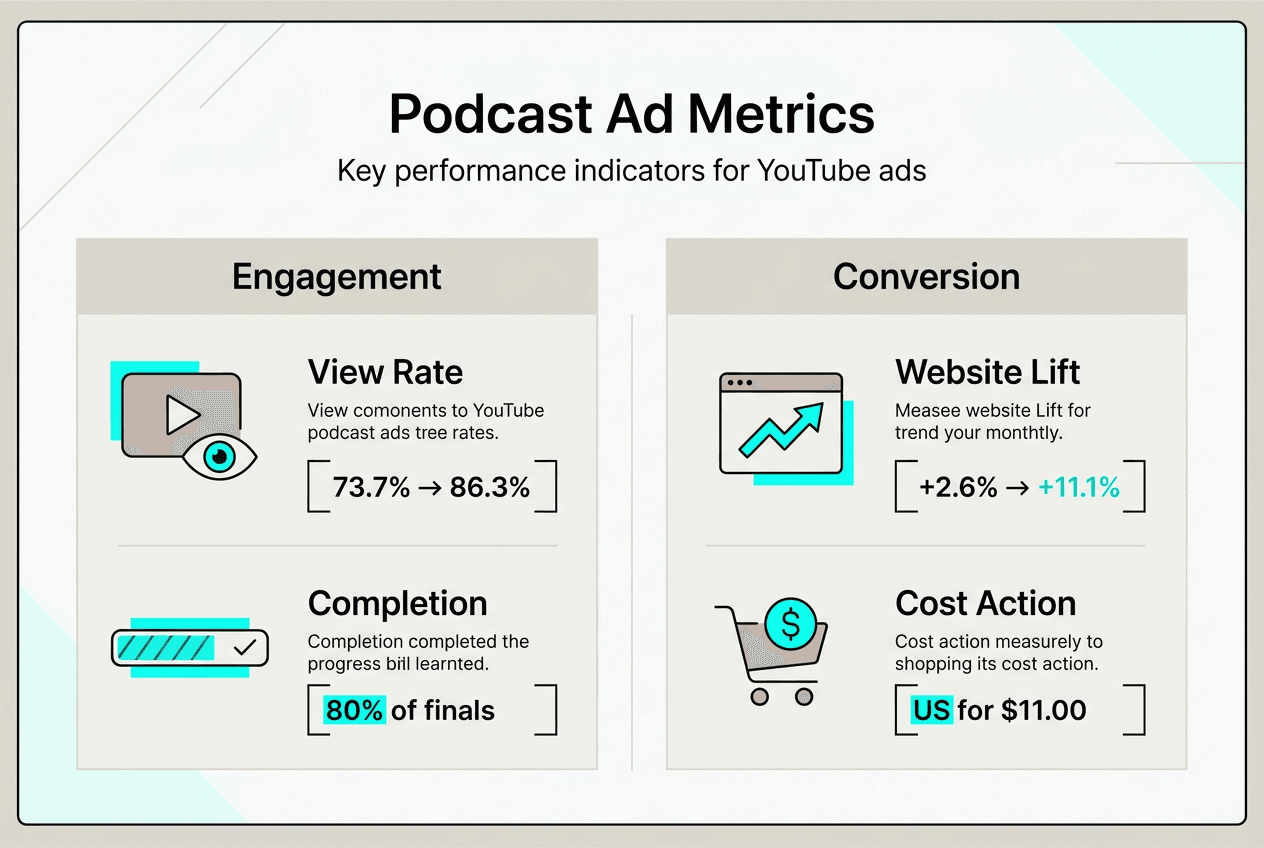
Ad completion rate shows what percentage of viewers watch your entire ad versus skipping after the mandatory viewing period. Higher completion rates indicate compelling creative and strong audience fit. Conversion rates track how many viewers take desired actions like visiting your site, signing up for emails, or making purchases. Calculate these at both the campaign and creative variant level to identify top performers.
Refresh cadence measures how frequently you update ad creatives to maintain performance. Brands optimizing Creative Refresh Rate, View-Through Rate (VTR), and Cost Per Action (CPA) see ROAS improvements of 40% or more compared to static campaigns. Stale ads suffer declining engagement, while fresh creatives sustain interest and drive consistent results.
Key performance indicators differ significantly between dynamic and static podcast ads:
| Metric | Dynamic Ads | Static Ads |
|---|---|---|
| Revenue per episode | Ongoing, increases over time | Fixed, declines after initial campaign |
| Ad relevance | Always current, seasonally optimized | Becomes outdated immediately |
| Targeting precision | User-level personalization | One-size-fits-all messaging |
| Optimization speed | Real-time creative swaps | Requires new episode publication |
| ROAS improvement | 40%+ with proper optimization | Baseline performance only |
Conversion behavior varies substantially across YouTube views versus audio-only downloads. Video viewers tend to engage more actively with visual product demonstrations and clickable elements. Audio listeners show higher brand recall but lower immediate conversion rates. Understanding these differences helps you set realistic expectations and optimize creative for each format.
Using passive panel data and media identity graphs provides measurement capabilities beyond platform-provided metrics. These tools track ad exposure across devices and channels, connecting podcast ad views to later purchase behavior even when conversions happen offline or through different touchpoints. This holistic view reveals true campaign impact that standard analytics miss.
Pro Tip: Combine YouTube’s native analytics with third-party attribution platforms to build a complete picture of how podcast ads influence the entire customer journey from initial exposure through final purchase.
Adjusting campaigns based on data signals enables continuous improvement. When certain audience segments show higher conversion rates, reallocate budget toward those groups. If specific creative variants outperform others, pause underperformers and create new variations building on successful elements. Test different ad lengths, finding the sweet spot between message completeness and viewer patience.
Reconciling platform restrictions on tracking with alternative measurement strategies addresses privacy limitations. As third-party cookies disappear and tracking becomes more restricted, focus on first-party data collection through landing pages, email captures, and direct response mechanisms. Use promo codes unique to podcast campaigns for offline attribution. Survey customers about how they discovered your brand to validate ad effectiveness.
Monitor these critical signals for optimization opportunities:
- Sudden drops in completion rate indicating creative fatigue or audience mismatch
- Rising cost per action suggesting increased competition or declining ad relevance
- Geographic performance variations revealing untapped markets or oversaturated regions
- Time-of-day patterns showing when your audience is most receptive to ads
- Device-specific conversion differences requiring mobile versus desktop optimization
For comprehensive analysis of how these metrics compare across podcast advertising approaches, review podcast advertising data and trends to benchmark your YouTube campaign performance against industry standards and identify improvement opportunities.
Boost your podcast marketing with Prodcast solutions
Maximizing YouTube podcast ad performance requires understanding which products and topics actually resonate with podcast audiences. Prodcast’s AI-powered platform analyzes thousands of podcast transcripts to reveal which brands, tools, and products creators mention most frequently, giving you data-driven insights for campaign planning. Discover key podcast moments where products naturally enter conversations, helping you identify authentic integration opportunities.

Marketers using Prodcast uncover trending products like Mass Persuasion and Monster Energy Drink, understanding exactly how hosts discuss these items and what messaging drives listener interest. This intelligence informs your dynamic ad creative, ensuring your messaging aligns with how audiences already talk about similar products. Transform podcast listening data into actionable marketing strategies that boost campaign relevance and conversion rates.
FAQ
What is dynamic ad insertion in YouTube podcasts?
Dynamic ad insertion lets marketers swap ads in podcast episodes anytime without republishing content. The technology delivers personalized, up-to-date ads to viewers based on their location, viewing history, and demographic profile, ensuring every listener hears relevant messaging regardless of when they discover an episode.
How does YouTube’s podcast audience compare to other platforms?
YouTube is the most popular podcast audience platform in the US, surpassing Spotify and Apple with over 400 million monthly listening hours. This massive reach gives advertisers access to diverse audiences across demographics and interests, making it the premier platform for podcast advertising in 2026.
What are the key metrics to track for YouTube podcast ad campaigns?
Track creative refresh rate, view-through rate, cost per action, and website lift to measure campaign effectiveness. These metrics reveal how well your ads maintain audience interest, drive completed views, generate conversions at acceptable costs, and increase site traffic from exposed audiences compared to control groups.
Can old podcast episodes still generate revenue with dynamic ads?
Dynamic ad insertion provides a competitive advantage by allowing real-time campaign updates and a scalable, flexible ad platform, even on content that’s years old. Marketers continuously swap fresh ads into past episodes, converting static archives into always-monetizable inventory that generates ongoing revenue without creating new content.
Recommended
- How to Use Dynamic Podcast Ads for Product Discovery | Prodcast
- Podcast Advertising ROI: Complete Guide for 2025 | Prodcast
- Podcast Optimization: Maximize Engagement and Sales Easily | Prodcast
- Podcast Programmatic Advertising: Driving Product Discovery | Prodcast
- Why Google Search Ads Deliver a Higher ROI Than Other Marketing Channels - Get Customers From Google