CATEGORIES
Unlock Effective Content Repurposing Strategies Today

Repurposing your content is more than a productivity hack and it can lead to a massive audience boost if you do it right. Most brands are sitting on a goldmine without even realizing it. Some blog posts pull in hundreds of views month after month but barely get reused at all. Why settle for a single hit when one great piece can be transformed and reach new audiences everywhere?
Table of Contents
- Step 1: Identify Your Core Content For Repurposing
- Step 2: Analyze Target Audience Needs And Preferences
- Step 3: Select Appropriate Formats For Repurposing
- Step 4: Create A Repurposing Schedule For Consistency
- Step 5: Execute The Repurposing Plan With Quality Checks
Quick Summary
| Key Point | Explanation |
|---|---|
| 1. Identify impactful content first | Conduct an audit to find high-performing content that can be repurposed effectively for various platforms. |
| 2. Understand your audience deeply | Gather data on audience preferences and behaviors to tailor your repurposed content to their needs. |
| 3. Choose suitable formats strategically | Select formats that align with the original message and audience consumption habits for better engagement. |
| 4. Create a consistent repurposing schedule | Develop a structured calendar to manage repurposing efforts and ensure regular content flow. |
| 5. Implement rigorous quality checks | Establish a comprehensive review process to maintain content integrity and relevance across platforms. |
Step 1: Identify Your Core Content for Repurposing
Successful content repurposing begins with strategic content identification. This crucial first step involves selecting the most impactful and versatile pieces from your existing content library that have significant potential for transformation and audience engagement.
Start by conducting a comprehensive audit of your existing content across all platforms. Look for high-performing assets that demonstrate consistent audience interest, such as blog posts with substantial page views, podcast episodes with high listener retention, or videos with significant engagement metrics. These pieces represent your content gold mines.
Analyzing your content performance requires a multi-dimensional approach. Review your website analytics, podcast listener statistics, and social media insights to pinpoint content that resonates most strongly with your audience. Pay special attention to pieces that generate consistent traffic, encourage meaningful interactions, or address complex topics that can be broken down into multiple formats.
Not all content is created equal when it comes to repurposing potential. Prioritize evergreen content that maintains relevance over time. These are typically comprehensive guides, in-depth explanations of complex topics, or strategic overviews that provide lasting value. Such content offers maximum flexibility for transformation across different media platforms.
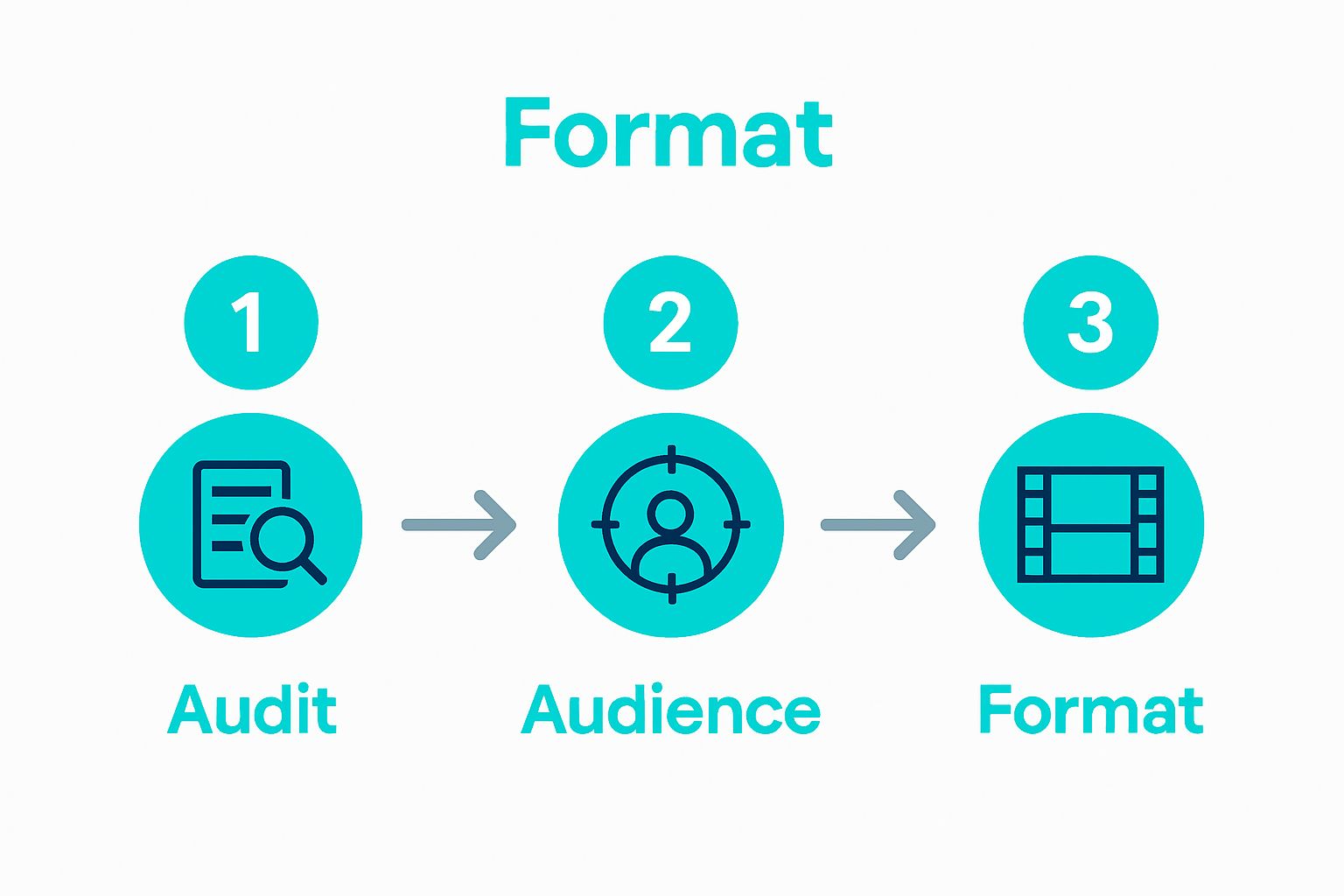
Consider creating a content inventory spreadsheet to track your most promising assets. Include columns for original content type, performance metrics, potential repurposing formats, and audience engagement data. This systematic approach will help you visualize your content’s adaptability and make informed repurposing decisions.
As you identify potential content for repurposing, read more about building a strategic content calendar to streamline your content strategy. Remember that the goal isn’t just to republish content, but to reimagine it in ways that provide fresh value and reach new audience segments.
Successful content identification means selecting pieces that are substantive enough to be reinterpreted yet flexible enough to be transformed across different mediums. Look for content rich in insights, storytelling potential, and educational value that can be adapted without losing its core message.
Step 2: Analyze Target Audience Needs and Preferences
Audience analysis is the critical bridge between content creation and meaningful engagement. This step transforms your repurposing strategy from generic content distribution to targeted, precision communication that resonates deeply with your specific audience segments.
Comprehensive audience research goes beyond basic demographics. Begin by collecting data from multiple touchpoints: podcast listener feedback, social media interactions, website analytics, and direct audience surveys. These insights will reveal not just who your audience is, but how they consume and interact with content across different platforms.
Utilize advanced analytics tools to decode audience behavior patterns. Look for nuanced signals like content consumption time, engagement rates, sharing frequencies, and interaction types. Pay special attention to the platforms where your audience spends the most time and the formats they find most compelling. This granular understanding helps you predict which content types will perform best during repurposing.
Develop audience personas that capture more than surface-level characteristics. These detailed profiles should include preferred content formats, learning styles, pain points, and communication preferences. For podcast audiences, this might mean understanding whether they prefer short, punchy clips or in-depth, long-form discussions. Learn more about understanding podcast audience engagement to refine your strategy.
Engagement metrics provide crucial insights into audience preferences. Track indicators like:
- Comment sentiment and frequency
- Social media share rates
- Time spent consuming different content formats
- Interaction levels across various platforms
Continuous audience research is key. Audiences evolve rapidly, so your analysis should be an ongoing process. Schedule quarterly reviews of your audience data to ensure your repurposing strategy remains aligned with changing preferences and consumption habits.
Successful audience analysis means developing an intuitive understanding of your listeners’ journey. Look for patterns that reveal how your content can provide value at different stages of their information-seeking process. This approach ensures that your repurposed content doesn’t just reach your audience, but genuinely connects with them.
Step 3: Select Appropriate Formats for Repurposing
Choosing the right content formats is a strategic art that transforms your existing content into versatile, engaging experiences across multiple platforms. This step is about understanding how to adapt your core message to different media channels while maintaining its essential value and impact.
Format selection requires a nuanced approach that considers both your content’s inherent strengths and your audience’s consumption preferences. Not every piece of content will work perfectly in every format, so you need to be selective and intentional. A podcast interview might translate brilliantly into a blog post, infographic, or social media series, but the transformation requires careful planning and creative reimagining.
Begin by mapping your original content’s core elements against potential new formats. Look for natural translation points that preserve the original message while offering a fresh perspective. For instance, a long-form podcast discussion about marketing strategies could be distilled into:
- Short, shareable quote graphics
- A detailed blog article expanding on key points
- A series of LinkedIn carousel posts
- A condensed YouTube video tutorial
Consider the technical and creative requirements of each potential format. Some formats demand higher production values or specific skill sets. A podcast transcript might require professional editing to become a polished written article, while creating video content could necessitate basic video editing skills or collaboration with multimedia professionals.
Platform-specific nuances matter tremendously. Each social media and content platform has unique audience expectations and technical constraints. Instagram demands visually striking, concise content, while LinkedIn favors more professional, text-rich presentations. Explore our guide on understanding podcast content marketing to dive deeper into platform-specific strategies.
Dynamic repurposing isn’t just about changing format it’s about reimagining content to provide maximum value. Think strategically about how each new format can offer a distinct perspective or solve a different audience need. A technical podcast episode might become an infographic for visual learners, a step-by-step blog post for detail-oriented readers, or a short animated video for those seeking quick insights.
Successful format selection means being flexible, creative, and audience-focused. Always prioritize clarity, engagement, and value over simply checking a repurposing box. Your goal is to create content experiences that feel native to each platform while maintaining the authentic core of your original message.
Below is a comparison of common content repurposing formats and their key suitability factors based on the original article.
| Format | When to Use | Audience Preference Example | Key Requirement |
|---|---|---|---|
| Blog Article | In-depth explanations, story-rich | Readers who prefer long-form text | Good writing/editing |
| Infographic | Visual summary, complex data | Visual learners, quick overviews | Design skills |
| Video (YouTube/Tutorial) | Step-by-step guides, dynamic content | Audiences seeking quick insights | Video editing/production |
| Podcast Clip/Highlight | Key takeaways, engaging moments | Listeners preferring short content | Audio editing |
| Social Media Carousel | Series of bite-sized tips | Social media users, mobile focus | Thumb-stopping visuals |
| Quote Graphic | Memorable quotes, notable facts | Shareable, visual-driven users | Design/simple editing |
| Article Series | Complex topics split into parts | Dedicated, detail-oriented readers | Structured outlining |

Step 4: Create a Repurposing Schedule for Consistency
Consistent content repurposing transforms sporadic efforts into a strategic, predictable content engine. This step is about creating a structured approach that ensures your repurposed content flows smoothly across platforms without overwhelming your production capabilities.
Developing a repurposing schedule requires careful planning and realistic goal setting. Start by mapping out your existing content inventory against potential repurposing opportunities. Create a comprehensive content calendar that outlines not just when original content will be released, but how and when each piece will be transformed into alternative formats.
Choose digital tools that support systematic content tracking and scheduling. Project management platforms like Trello, Asana, or dedicated content calendar tools can help you visualize your repurposing workflow. These tools enable you to assign specific tasks, set deadlines, and track the progress of each content transformation.
Establish a realistic cadence that balances content quality with production capacity. Not every piece of content needs immediate or multiple repurposings. Prioritize high-performing content and create a tiered approach to your repurposing strategy. Some top-tier content might be repurposed across 3-4 formats, while others might receive more minimal adaptation.
Consider creating a systematic rotation that prevents audience fatigue. Your repurposing schedule should include:
- Optimal timing between original and repurposed content releases
- Varied platforms for content distribution
- Unique angles or perspectives for each format
- Buffer time for content creation and editing
Track and measure the performance of your repurposed content to continuously refine your approach. Learn more about building a strategic content calendar to maximize your content’s potential and maintain audience engagement.
Flexibility is crucial in content scheduling. While consistency matters, your repurposing schedule should not become a rigid constraint. Be prepared to adapt based on audience feedback, trending topics, and unexpected opportunities. Some of the most successful content strategies emerge from the ability to pivot and respond to real-time audience interests.
Successful content scheduling means creating a living, breathing system that evolves with your brand and audience. Regularly review your repurposing calendar, analyze performance metrics, and be willing to experiment. The goal is not perfect execution, but continuous improvement and audience connection.
Step 5: Execute the Repurposing Plan with Quality Checks
Executing your content repurposing strategy demands precision, creativity, and a rigorous quality control process. This critical stage transforms your carefully planned content into polished, platform-specific assets that maintain the integrity of your original message while speaking the language of each unique audience.
Quality checks are the cornerstone of successful content repurposing. Begin by establishing a comprehensive review process that goes beyond basic grammar and spelling checks. Each repurposed piece must undergo a multi-stage evaluation that ensures accuracy, relevance, and alignment with your brand’s voice across different platforms.
Implement a systematic workflow that breaks down the repurposing execution into clear, manageable stages. Start with content deconstruction, where you carefully extract the core message and key insights from your original content. Then, methodically reconstruct these elements to fit the specific requirements of your target format and platform.
Technology can be a powerful ally in maintaining content quality. Use advanced editing tools, grammar checkers, and AI-assisted writing assistants to streamline your review process. These tools can help identify potential issues with tone, readability, and consistency that might slip past manual review.
Your quality control checklist should include critical verification points:
- Accuracy of original information
- Consistent brand voice and messaging
- Platform-specific formatting and style requirements
- Engagement potential and audience relevance
- Technical compatibility across different media
Explore our guide on understanding podcast content marketing to gain deeper insights into maintaining content quality across different platforms. The key is to approach each repurposed piece as a unique creation that stands on its own while remaining true to the original content’s essence.
Collaborative review is crucial. Engage multiple team members with different perspectives to provide comprehensive feedback. This might include subject matter experts, content creators, and audience representatives who can offer diverse insights into the repurposed content’s effectiveness.
Successful execution means treating each repurposed piece as a precision instrument. Your goal is not just to reproduce content, but to craft meaningful, platform-optimized experiences that resonate with your audience. Continuously track performance metrics, gather feedback, and be prepared to iterate and improve your repurposing approach with each new iteration.
Use this checklist to verify each repurposed content piece meets quality standards throughout the process.
| Quality Checkpoint | Purpose | Responsible Team Role |
|---|---|---|
| Review original information | Ensure core message and data are accurate | Subject Matter Expert |
| Maintain brand voice | Preserve tone and style across platforms | Content Editor |
| Platform-specific formatting | Adhere to style and technical requirements | Platform Specialist |
| Check for engagement potential | Verify content is likely to spark audience action | Community Manager |
| Test technical compatibility | Ensure proper display/function across media | QA/Technical Reviewer |
| Collaborative feedback | Gain diverse perspectives for improvement | Cross-functional Team |
| Final approval & publishing | Sign off on content readiness | Project Lead/Manager |
Transform Content Repurposing with AI-Powered Podcast Insights
Are you tired of seeing your most valuable content go unnoticed or struggle to reach new audiences across platforms? As discussed in “Unlock Effective Content Repurposing Strategies Today,” selecting the right assets, understanding your audience, and maintaining quality during repurposing are critical but often overwhelming. Creators and entrepreneurs consistently face the pain of content sitting idle, missing out on the engagement and conversions it deserves.
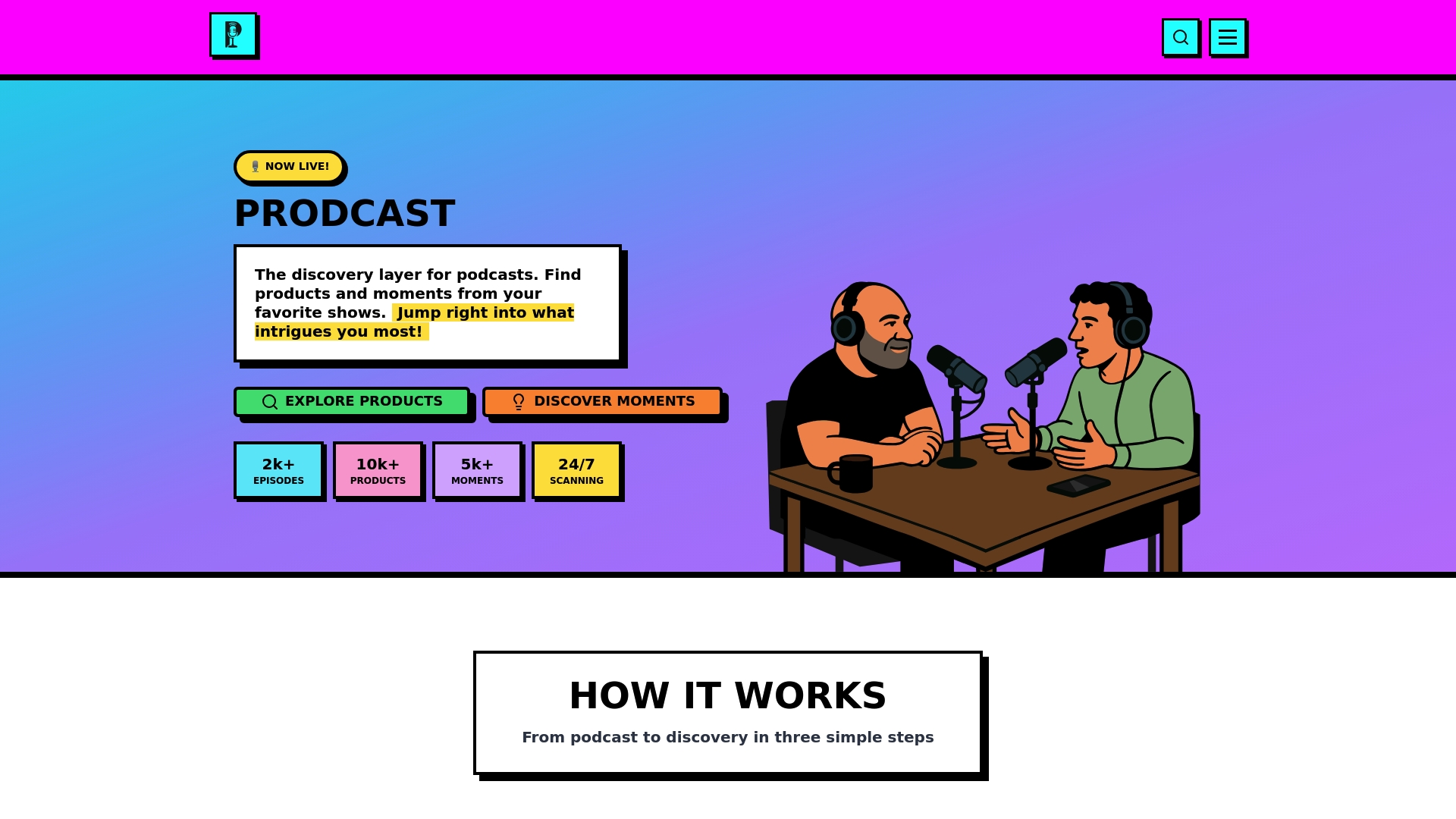
Shift from passive publishing to active engagement by leveraging Prodcast’s advanced AI. Our platform analyzes podcast content, pinpoints strategic product mentions and memorable moments, and allows you to showcase your products to an already engaged audience. Unlock new channels for your content by seamlessly connecting listeners with your offerings, boosting both your reach and revenue. Ready to see how effective repurposing can become? Visit Prodcast’s main site to start transforming every piece of content into an actionable opportunity today.
Frequently Asked Questions
What is content repurposing and why is it important?
Content repurposing is the process of transforming existing content into new formats to reach different audience segments. It helps maximize the value of your work and improves engagement by presenting information in various ways.
How do I identify which content to repurpose?
Start by conducting a thorough audit of your existing content, focusing on those with high performance metrics like page views, listener retention, or social media engagement. Create a spreadsheet to track and prioritize pieces that are evergreen and rich in insights.
What formats can I use for repurposing content?
You can transform your content into various formats, such as blog posts, videos, infographics, podcasts, or social media snippets. Choose formats that align with your audience’s preferences and the strengths of the original content for the best results.
How can I create a repurposing schedule?
Develop a content calendar that outlines when original content is released and how it will be transformed into new formats. Aim for a consistent cadence, such as repurposing high-performing pieces every 4-6 weeks, to maintain audience engagement without overwhelming your team.
What steps should I take to ensure quality in my repurposed content?
Implement a multi-stage review process that includes verification of accuracy, brand voice consistency, and adherence to platform requirements. Use editing tools to assist in the revision process and engage team members for collaborative feedback before publishing.
How often should I analyze audience preferences for content repurposing?
Continuously analyze audience preferences by reviewing engagement metrics and feedback every quarter. Staying responsive to changing audience habits ensures your repurposed content remains relevant and effective.
Recommended
- What is Content Syndication? Understanding Its Impact | Prodcast
- Build a Content Calendar for Your Brand Success in 2025 | Prodcast
- Understanding Podcast Content Marketing for Brands | Prodcast
- Master Keyword Ranking Strategies for 2025 Success | Prodcast
- How to Repurpose Content for Maximum Reach and Impact
- 7 Content Curation Strategies Every Business Owner Needs – My Blog