CATEGORIES
TAGS
Unlock the power of podcast as marketing channel in 2026

Podcast advertising delivers 2.5x higher brand recall than traditional digital ads, yet most marketers still overlook this powerful channel. With podcast ad spending projected to grow at 27.8% annually, understanding how to leverage host-read ads, direct buys, and emerging attribution tools separates winning campaigns from wasted budgets. This guide reveals data-driven strategies to maximize ROI through effective podcast marketing in 2026, from choosing the right ad formats to measuring success accurately and scaling campaigns that truly connect with engaged audiences.
Table of Contents
- Understanding Podcast Advertising Formats And Their Impact
- Navigating Podcast Ad Buying Methods: Direct, Network, And Programmatic
- Measuring Success And Overcoming Attribution Challenges In Podcast Marketing
- Maximizing ROI: Strategic Tips And Real-World Insights For Podcast Marketing In 2026
- See How Prodcast Empowers Your Podcast Marketing
Key takeaways
| Point | Details |
|---|---|
| Host-read mid-roll ads deliver best results | These authentic placements generate 2.5x higher brand recall compared to pre-produced spots and dominate 68% of podcast inventory. |
| Direct buys offer superior niche targeting | Working directly with podcasters ensures audience fit and relationship benefits, while programmatic provides scale for broader campaigns. |
| Attribution challenges require creative solutions | Using promo codes, vanity URLs, and dynamic ad insertion helps overcome the 64% of marketers who struggle with podcast attribution. |
| Testing niche-fit shows maximizes ROI | Starting with 10-20 targeted podcasts outperforms betting big on large mismatched shows, reducing waste and improving conversion rates. |
| Podcast marketing grows 27.8% annually | Early investment in this expanding channel positions brands to capture highly engaged audiences before competition saturates the space. |
Understanding podcast advertising formats and their impact
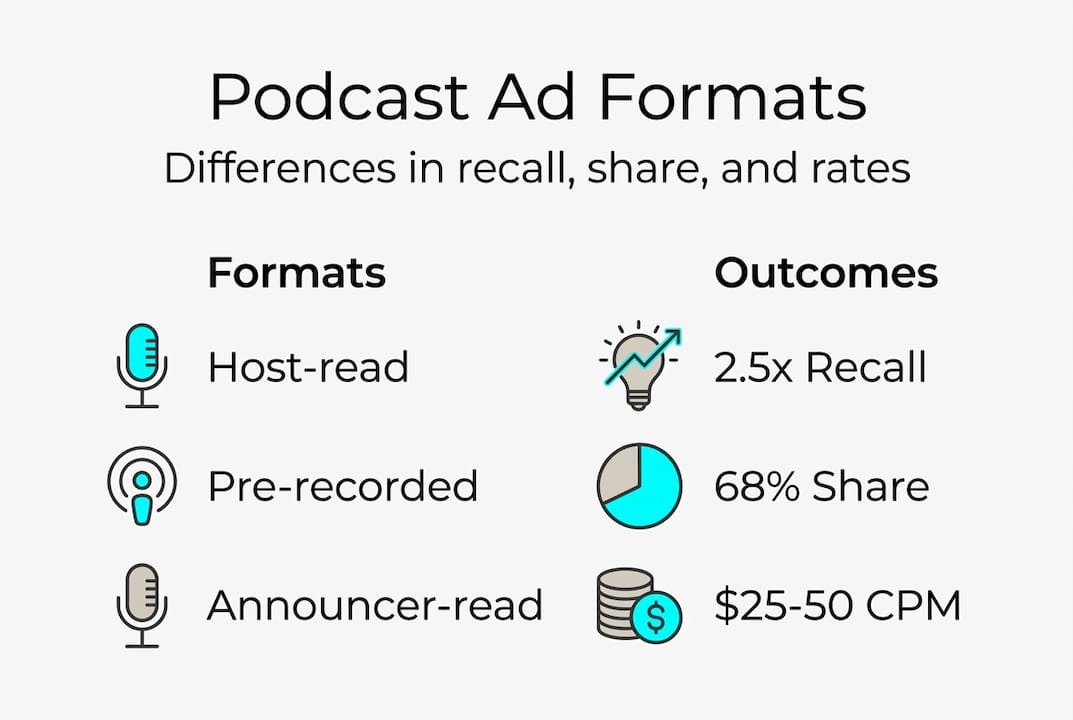
Podcast ads come in three primary formats, each with distinct characteristics affecting performance and cost. Host-read ads feature the podcast creator personally delivering your message in their own voice, often weaving brand mentions naturally into content. Pre-produced ads are professionally recorded commercials inserted into episodes, similar to traditional radio spots. Dynamic ad insertion (DAI) uses technology to programmatically place ads into episodes after publication, allowing for targeting and updating campaigns without re-recording.
Host-read ads outperform other formats by 2.5x in brand recall and dominate inventory at 68% because they leverage the trust podcasters build with their audiences. When a host authentically recommends your product, listeners perceive it as a genuine endorsement rather than an interruption. This authenticity translates directly to higher engagement and purchase intent compared to generic commercial spots.

Placement within episodes matters just as much as format. Mid-roll placements produce best engagement and recall because they appear when listeners are most engaged, typically 20-40 minutes into an episode after audiences have committed to finishing. Pre-roll ads at the beginning risk being skipped, while post-roll ads suffer from listener drop-off before episodes end. Mid-roll positions capture attention during peak engagement windows.
CPM rates vary significantly by format and placement, ranging from $18 to $50 depending on audience size and niche. Host-read mid-roll ads command premium pricing at $25-50 CPM because they deliver superior results. Pre-produced spots cost less at $18-30 CPM but sacrifice the authenticity that drives conversions. Dynamic insertion falls somewhere between, offering flexibility at $20-35 CPM while lacking the personal touch of host reads.
| Ad Format | Inventory Share | Typical CPM | Brand Recall |
|---|---|---|---|
| Host-read | 68% | $25-50 | 2.5x baseline |
| Pre-produced | 22% | $18-30 | 1x baseline |
| Dynamic insertion | 10% | $20-35 | 1.3x baseline |
Pro Tip: Prioritize host-read mid-roll ads for your first podcast campaigns to maximize ROI while building baseline performance data for future optimization.
Understanding these format differences helps marketers allocate budgets strategically. Testing different combinations reveals which formats resonate with your target audience, but starting with proven high-performers reduces risk. For detailed performance benchmarks across industries, explore podcast ad effectiveness data to inform your strategy.
Navigating podcast ad buying methods: direct, network, and programmatic
Marketers access podcast inventory through three distinct buying methods, each offering different trade-offs between control, scale, and cost. Direct buys involve negotiating placements directly with individual podcasters or their representatives, creating opportunities for customized messaging and relationship building. Podcast ad networks aggregate inventory from multiple shows, providing broader reach through a single point of contact. Programmatic platforms automate buying across thousands of podcasts using technology similar to display advertising.
Direct buys offer best fit and highest engagement because you handpick shows matching your target audience precisely. Working directly with hosts allows for collaborative creative development, ensuring ads feel native to each podcast’s style and tone. This personalization drives stronger performance but requires more time investment to identify, vet, and negotiate with individual creators. CPM rates for direct buys typically range from $25-50, reflecting the premium value of targeted, authentic placements.
Podcast ad networks streamline the buying process by bundling shows into categories like business, health, or technology. Networks handle production, trafficking, and reporting while providing access to multiple shows through one contract. This middle-ground approach balances personalization with efficiency, though you sacrifice some control over exact placement timing and creative execution. Network CPMs average $20-40, offering reasonable rates with moderate scale.
Programmatic advertising accounts for 25% of podcast ad spend, delivering massive scale through automated buying platforms. Advertisers set targeting parameters like demographics, interests, or listening behavior, and algorithms place ads across matching inventory. While programmatic enables reaching millions of listeners quickly, it sacrifices the personal touch that makes podcast ads effective. Generic, pre-produced spots inserted programmatically lack host endorsement authenticity, resulting in lower engagement despite broader reach. Programmatic CPMs range from $15-30, the lowest rates but also the least personalized approach.
| Buying Method | Best For | Typical CPM | Personalization | Scale |
|---|---|---|---|---|
| Direct | Niche targeting | $25-50 | Highest | Low |
| Network | Balanced reach | $20-40 | Medium | Medium |
| Programmatic | Mass awareness | $15-30 | Lowest | Highest |
Choose your buying method based on campaign goals and resources:
- Select direct buys when targeting specific niche audiences where precise fit matters more than volume
- Use networks to test multiple shows efficiently while maintaining reasonable creative control
- Deploy programmatic for broad awareness campaigns where scale outweighs personalization needs
- Avoid choosing shows solely by download numbers without considering audience alignment
Many successful marketers adopt hybrid approaches, using direct buys for core niche shows while supplementing with network or programmatic inventory for broader reach. This combination captures high-intent audiences through targeted placements while building general awareness cost-effectively. For insights on scaling podcast programmatic advertising effectively, explore strategies that balance automation with authenticity.
Measuring success and overcoming attribution challenges in podcast marketing
Tracking podcast ad performance requires creative measurement approaches because traditional digital tracking pixels don’t work in audio-only environments. Marketers rely on several tools to connect podcast exposure to downstream actions. Promo codes give listeners unique discount codes mentioned in ads, allowing brands to track redemptions back to specific shows or episodes. Vanity URLs create custom landing pages like brandname.com/podcastname that capture traffic sources. Pixel tracking places cookies when listeners visit promoted URLs, enabling retargeting and conversion tracking.
Brand lift studies measure changes in awareness, consideration, or purchase intent among exposed versus unexposed audiences through surveys. These studies provide directional insights into campaign impact even when direct attribution proves difficult. Dynamic ad insertion improves tracking by linking individual ad impressions to listener behavior over time, though offline listening still creates blind spots. Combining multiple measurement methods paints a more complete picture than relying on any single metric.
64% of marketers cite attribution as the top challenge in podcast advertising because listeners often hear ads while commuting, exercising, or doing chores, then take action hours or days later on different devices. This delayed, cross-device behavior breaks traditional attribution models designed for immediate click-through responses. Additionally, many podcast apps don’t support the tracking technologies that power digital advertising measurement, creating technical barriers to accurate data collection.
“Attribution remains the biggest hurdle for podcast advertisers, with 64% struggling to connect audio exposure to conversions across devices and time delays.”
Best practices for improving attribution accuracy include:
- Launch campaigns with unique promo codes that clearly identify each podcast source
- Create dedicated landing pages with tracking parameters to isolate podcast traffic
- Survey customers about how they discovered your brand to capture qualitative attribution data
- Use incrementality testing by comparing sales during campaign periods versus baseline periods
- Implement multi-touch attribution models that credit podcast touchpoints alongside other channels
Pro Tip: Use early campaign promo code redemption rates as benchmarks to optimize future podcast selections and creative messaging before scaling budgets.
Emerging technologies are gradually improving podcast attribution capabilities. Server-side ad insertion creates more trackable impressions by logging when ads play rather than relying on client-side reporting. Advanced analytics platforms now integrate podcast data with CRM systems, connecting audio exposure to customer journeys. As measurement tools evolve, marketers gain clearer ROI visibility, making podcast advertising more accountable and easier to justify within marketing budgets. Explore comprehensive podcast engagement metrics to understand which indicators matter most for campaign success.
Maximizing ROI: strategic tips and real-world insights for podcast marketing in 2026
Successful podcast marketing in 2026 requires strategic planning that prioritizes audience fit over vanity metrics. Niche-fit shows with host-read mid-roll ads yield highest ROI, while testing 10-20 shows and avoiding overspending on large mismatched podcasts is critical for efficient budget allocation. Focus on premium demographics and trust-building over sheer download volume, as engaged niche audiences convert at higher rates than massive but indifferent listener bases.
Critical do’s and don’ts for podcast campaign success:
- Do prioritize shows where hosts genuinely use or could authentically endorse your product
- Do negotiate multi-episode commitments to build frequency and listener familiarity
- Do give hosts creative freedom to present your message in their authentic voice
- Don’t choose podcasts based solely on download numbers without audience analysis
- Don’t over-script host-read ads, as rigid scripts destroy the authenticity that drives performance
- Don’t expect immediate conversions; podcast attribution often requires 7-14 day windows
Testing and scaling campaigns systematically maximizes learning while controlling risk:
- Set initial test budgets at 10-15% of total planned spend to validate approach
- Select 10-20 niche shows matching your ideal customer profile precisely
- Measure early performance using promo codes and surveys to identify top performers
- Optimize creative messaging based on which shows and ad styles drive best response
- Scale budget into proven winners while cutting underperforming placements quickly
- Continuously test new shows to expand reach without sacrificing efficiency
Pro Tip: Avoid scripting hosts with rigid talking points; instead, provide key messages and let them craft authentic endorsements that resonate with their specific audiences.
Common pitfalls that undermine podcast marketing ROI:
- Buying large podcasts with mismatched audiences just because they have impressive download numbers
- Running campaigns too short to build the frequency needed for audio advertising impact
- Using pre-produced generic ads instead of investing in authentic host-read placements
- Failing to provide hosts with actual product samples or experiences before recording ads
- Expecting instant results without accounting for the delayed attribution typical of audio channels
- Ignoring qualitative feedback from customer surveys that reveal podcast influence
Emerging trends shaping podcast marketing growth include the 27.8% CAGR projection driven by increasing listener adoption and advertiser sophistication. Hybrid buying strategies combining direct relationships for core shows with programmatic scale for broader awareness are becoming standard practice. Host-read ads continue dominating because they deliver stronger long-term brand effects than interruptive commercial spots, even as dynamic insertion technology improves targeting capabilities.
Early investment in podcast marketing positions brands to capture highly engaged audiences before competition saturates the channel. Podcasts attract listeners actively seeking information and entertainment, creating receptive environments for relevant brand messages. As attribution technology improves and more marketers master podcast-specific strategies, costs will likely rise, making 2026 an optimal time to establish presence and build expertise. For comprehensive guidance on measuring returns, review the podcast advertising ROI guide covering advanced optimization tactics.
See how Prodcast empowers your podcast marketing
Applying these podcast marketing strategies becomes significantly easier when you can identify exactly which shows discuss relevant products and topics. Prodcast analyzes thousands of podcast transcripts to reveal product mentions, expert recommendations, and key discussion moments across industries. Discover engaging podcast moments clips that showcase how hosts naturally discuss products, helping you identify authentic partnership opportunities. Explore trending products like mass persuasion and game changers to understand what audiences are hearing and caring about right now.

Prodcast transforms spoken-word content into structured, searchable data, giving marketers real-time insights into which brands, tools, and products are trending across podcasts. This intelligence helps you select shows where your products already fit naturally into conversations, maximizing the authenticity that drives podcast ad performance. Whether you’re planning direct buys or scaling programmatic campaigns, Prodcast’s data-driven approach ensures you invest in podcasts where your message will resonate most effectively with engaged listeners.
FAQ
What are the most effective podcast ad formats in 2026?
Host-read mid-roll ads lead with 2.5x higher brand recall due to authenticity and trust, significantly outperforming pre-produced and dynamically inserted ads. These placements work because hosts personally endorse products in their own voice during peak listener engagement windows. Mid-roll positioning captures attention when audiences are most committed to finishing episodes, while host credibility transforms ads into trusted recommendations rather than interruptions.
How can marketers measure podcast ad success accurately?
Using promo codes, vanity URLs, pixel tracking, and brand lift studies helps track performance despite attribution challenges inherent in audio advertising. Dynamic ad insertion improves attribution accuracy over time by linking impressions to listener behavior. Combining multiple measurement methods including customer surveys provides more complete ROI visibility than relying on any single metric, especially given the delayed, cross-device conversion patterns typical of podcast audiences.
What podcast buying method best suits niche brands?
Direct buys offer tailored fit and better engagement for niche brands by enabling precise audience targeting and collaborative creative development with hosts. While programmatic suits scale, it sacrifices the personalization that makes podcast ads effective for specialized products. Direct relationships allow for authentic endorsements where hosts genuinely use and recommend products, driving higher conversion rates despite requiring more time investment in show selection and negotiation.
Why should brands avoid picking shows by download numbers alone?
High downloads don’t guarantee audience fit, and wasting budget on large but mismatched shows undermines ROI compared to targeted niche podcasts. A show with 100,000 downloads but poor audience alignment will underperform a 10,000-download podcast where listeners perfectly match your customer profile. Engagement quality, demographic fit, and host credibility matter far more than raw size when predicting campaign success and cost efficiency.
What key trends will shape podcast marketing growth in 2026?
Podcast advertising expected to grow 27.8% annually, with hybrid direct and programmatic buying and emphasis on host-read ads driving stronger long-term brand effects. Attribution technology improvements are making ROI measurement more accurate, while increasing listener adoption expands available audiences. Early investment positions brands to capture engaged listeners before competition saturates the channel and drives costs higher, making 2026 an optimal entry point for marketers building podcast expertise.