CATEGORIES
TAGS
Why podcasts matter for brands: drive engagement and trust

TL;DR:
- Podcast audiences are highly engaged, trusting, and purchase-ready, offering significant growth opportunities for brands.
- Targeting niche genres and using host-read ads enhances authenticity, trust, and conversion rates.
- Effective measurement combines multiple signals like brand lift, promo codes, and search volume for accurate ROI assessment.
Most brand managers treat podcasts like a side dish. Social media gets the budget, the strategy meetings, and the creative energy. Podcasts get whatever’s left over. But here’s what the data keeps telling us: podcast audiences are among the most engaged, most trusting, and most purchase-ready consumers you can reach. They’re not scrolling past your message in 1.3 seconds. They’re listening, often for 30 minutes or more, with both earbuds in. If your brand is still treating podcasts as a niche add-on, you’re leaving real growth on the table.
Table of Contents
- Why podcasts build deeper connections than social media
- The power of podcast audiences: niche targeting and authentic engagement
- How to measure podcast impact on brand campaigns
- Risks, misconceptions, and industry trends for podcast marketing
- What most marketers still miss about podcast brand impact
- Boost brand engagement with curated podcast moments
- Frequently asked questions
Key Takeaways
| Point | Details |
|---|---|
| Sustained engagement | Podcast audiences listen for longer, fostering deeper brand familiarity than social or video ads. |
| Host-led trust boosts ROI | Host-read recommendations influence buyer decisions more than traditional influencer marketing. |
| Niche targeting works | Brands can reach valuable micro-segments efficiently with genre and audience data. |
| Measure and adapt | Brand lift studies, promo codes, and search data provide actionable campaign performance insights. |
| Manage industry risks | Stay alert to ad fatigue, fraud, and shifting trends to preserve podcast ROI. |
Why podcasts build deeper connections than social media
Let’s be honest. Social media is loud. Every brand is competing for the same half-second of attention between cat videos and political arguments. Podcasts are a completely different environment.
Sustained listener attention of 30+ minutes per episode means your brand message isn’t fighting for a sliver of focus. It’s part of a conversation someone chose to have. That’s a fundamentally different relationship between content and consumer.
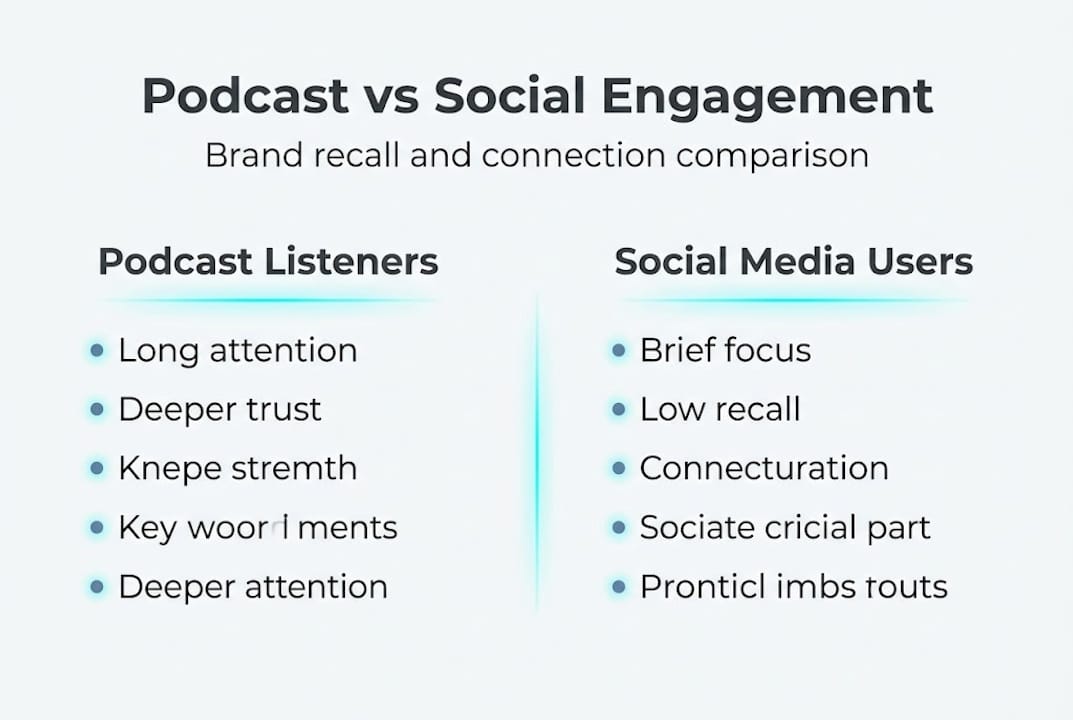
Think about what that means for brand recall. When a host spends two minutes talking about a product they genuinely use, in their own words, during an episode someone is fully absorbed in, that sticks. It’s not a banner ad. It’s a recommendation from someone the listener has spent dozens of hours with.
The trust factor here is real and measurable. 56% of weekly listeners identify podcast hosts as their most trusted voices, and 67% have purchased a product because of a podcast sponsor recommendation. Compare that to the skepticism most people bring to Instagram influencer posts, and the gap becomes obvious.
Here’s what makes podcast brand connections work so well:
- Sustained attention: Listeners commit to episodes, giving your message room to land
- Narrative context: Products get introduced through stories, not just slogans
- Host credibility: Recommendations feel personal, not transactional
- Emotional resonance: Long-form audio builds genuine affinity over time
- Native integration: Ads feel like part of the show, not interruptions
“Podcast hosts build stronger trust than social influencers. That trust translates directly into purchase behavior in a way that most digital channels simply can’t replicate.”
If you want to go deeper on turning these dynamics into real campaign strategy, data-driven podcast strategies are worth exploring. And if you’re still skeptical about whether podcasts influence buying decisions at scale, the numbers make a compelling case.
The bottom line: podcasts don’t just reach people. They reach people when they’re ready to listen.
The power of podcast audiences: niche targeting and authentic engagement
With a clear view of how podcasts forge trust, it’s essential to see why their unique audiences are a goldmine for brands seeking niche reach.

Podcast genres are essentially pre-built audience segments. True crime fans. Biohackers. Solo entrepreneurs. New parents. Fantasy football obsessives. Each show attracts a specific type of person with specific interests, values, and spending habits. That’s not an accident. It’s an opportunity.
For brand managers, this means you can get granular in a way that broad social media buys rarely allow. A fitness supplement brand placing a host-read ad on a strength training podcast isn’t just reaching “health-conscious people.” It’s reaching people who already care about performance nutrition, who trust the host’s opinion on what works, and who are actively looking for product recommendations.
Here’s how to put this into practice:
- Identify your audience segments by mapping your buyer personas to podcast genres and specific shows
- Prioritize mid-roll, host-read placements over pre-roll or programmatic insertions for maximum authenticity
- Track results with unique promo codes or custom landing pages tied to each show
- Run brand lift studies to measure awareness shifts beyond direct conversions
- Iterate based on performance data, not just download counts
| Ad format | Authenticity | Targeting precision | Measurement ease |
|---|---|---|---|
| Host-read, mid-roll | Very high | High | Moderate |
| Pre-roll, host-read | High | High | Moderate |
| Programmatic insertion | Low | Moderate | High |
| Sponsorship segment | Very high | High | Low |
Host-read ads consistently outperform programmatic placements in both trust and conversion. The authenticity is baked in. Listeners know the host has agreed to talk about the product, and that implicit endorsement carries weight.
Pro Tip: Don’t chase the biggest shows. A podcast with 8,000 deeply engaged listeners in your exact niche will often outperform a show with 200,000 casual listeners. Explore podcast sponsorship outcomes to see how smaller, targeted placements stack up, and use data-driven strategies to identify the right shows before you commit budget.
How to measure podcast impact on brand campaigns
After discussing how targeting and authenticity pay off, brands must know how to quantify their podcast marketing results.
Measurement is where a lot of brands get frustrated with podcasts. Unlike paid social, you can’t just check a dashboard and see exactly who clicked what. But that doesn’t mean podcasts are unmeasurable. It means you need the right tools and a realistic framework.
The most reliable measurement methodologies combine multiple signals: brand lift studies, promo codes, direct traffic spikes, and branded search volume. No single method tells the full story, but together they paint a clear picture.
Here’s a comparison of the main options:
| Method | Granularity | Accuracy | Scale | Best for |
|---|---|---|---|---|
| Brand lift study | High | High | Medium | Awareness campaigns |
| Promo code tracking | Medium | High | High | Direct response |
| Branded search attribution | Medium | Medium | High | Long-term brand building |
| Direct traffic analysis | Low | Medium | High | Quick pulse checks |
Best practices for getting accurate numbers:
- Use unique promo codes per show, not shared codes across campaigns
- Set a measurement window of at least 30 days after the episode drops
- Track branded search volume before, during, and after the campaign
- Run a holdout group if budget allows, to isolate podcast-driven lift
- Don’t judge a campaign on a single episode. Frequency matters.
The brands that get the best results from podcast advertising effectiveness are the ones that commit to a measurement framework before the campaign launches, not after. And if you’re building a business case internally, a solid guide to measuring podcast ROI can help you frame the conversation with stakeholders.
Risks, misconceptions, and industry trends for podcast marketing
Understanding how to measure success, it’s equally important to recognize pitfalls and the changing landscape of podcast advertising.
Not every podcast campaign is a home run. The medium has real risks, and some of the assumptions brands bring to it are flat-out wrong. Let’s clear a few things up.
Misconception 1: All genres work equally well. They don’t. Highly saturated categories like true crime and general business have seen listener fatigue with ad loads. Niche genres with passionate communities still deliver strong results.
Misconception 2: CPMs are always worth the premium. Podcast CPMs can run higher than other audio formats. That premium is justified when the audience match is tight and the host has real credibility. It’s not justified when you’re buying reach for its own sake.
Misconception 3: Fraud isn’t an issue. It is. Oversaturation risks like ad fatigue and inflated download metrics are real concerns, and some networks have faced scrutiny over how they count listens. Verify your partners carefully.
Key risks to watch and how to counter them:
- Ad fatigue: Limit frequency and rotate creative to keep messaging fresh
- Genre saturation: Prioritize emerging shows in growing niches over crowded categories
- Download inflation: Use third-party verification and focus on engagement signals, not just raw numbers
- Over-reliance on one show: Diversify across multiple hosts and formats
- Short campaign windows: Podcast brand lift builds over time. One episode rarely moves the needle alone.
The podcast ad market trends are shifting toward more accountability and transparency, which is good news for serious marketers. And keeping up with podcast marketing shifts in 2026 means staying ahead of the saturation curve before it catches up with your campaigns.
The brands winning right now are the ones treating podcast advertising as a craft, not a checkbox.
What most marketers still miss about podcast brand impact
Here’s an uncomfortable truth: most marketers evaluate podcast campaigns the same way they evaluate display ads. They want a clean CPA number, a click-through rate, and a tidy attribution report. When those numbers don’t materialize in the first two weeks, they pull the budget.
That’s the wrong lens entirely.
Podcasts work through accumulated trust. A listener who hears your brand mentioned across five episodes over three months doesn’t just remember you. They feel like they know you. That’s not a metric that shows up in a last-click attribution model, but it’s real, and it compounds.
The brands that see the strongest long-term returns from product discovery through podcasting are the ones treating it like a relationship channel, not a performance channel. They show up consistently. They let hosts tell the story in their own voice. They measure brand equity shifts over quarters, not days.
Pro Tip: Build a 90-day minimum commitment into any podcast campaign. The first few episodes are planting seeds. The payoff comes when listeners have heard your name enough times that it feels familiar and trusted. Patience here isn’t passive. It’s strategic.
Boost brand engagement with curated podcast moments
If you’ve made it this far, you already know podcasts are more than a secondary channel. They’re where real influence lives. Now the question is: how do you tap into it efficiently?

Prodcast makes it easy to find the exact moments that matter. Our platform scans thousands of podcast transcripts to surface product mentions, brand discussions, and expert endorsements across every major genre. Instead of scrubbing through hours of audio, you get the good stuff, organized and searchable, ready to fuel your next campaign. Explore curated podcast moments to see what’s resonating right now, or check out brand storytelling episodes to find authentic narratives you can build on. Learn more on Prodcast and turn podcast conversations into your brand’s next big move.
Frequently asked questions
How much audience attention do podcasts really provide compared to other media?
Podcast listeners engage for 30+ minutes per episode on average, which far exceeds the fleeting attention typical of social media feeds or pre-roll video ads. That sustained focus gives your brand message genuine room to land.
Why do host-read podcast ads convert better than traditional influencer marketing?
56% of weekly listeners trust podcast hosts more than social influencers, and 67% have made a purchase based on a host recommendation. That trust gap is what drives the conversion difference.
What are the main risks of podcast marketing for brands?
The biggest risks are ad fatigue, genre oversaturation, and inflated download metrics that can make campaigns look better than they are. Careful partner vetting and diversified placements help manage all three.
How can brands accurately measure podcast campaign success?
Brand lift studies, promo codes, and branded search tracking are the most reliable methods, and combining all three gives you the clearest picture of true campaign impact.
Which types of brands benefit most from podcast ads?
DTC brands with straightforward offers see strong direct response results, while B2B brands benefit more from awareness and consideration building over longer sales cycles.
Recommended
- How podcasts drive sales: data-backed strategies for mark… | Prodcast
- How podcasts drive sales: data-backed strategies for mark… | Prodcast
- Podcast Engagement Metrics: What Brands and Listeners Nee… | Prodcast
- Boost podcast audience engagement with proven data insights | Prodcast
- 🚀 Personalization and Digital Experience: HOW TO ENGAGE THE CLIENT from the First Moment | Sales Mates Podcast #61 - Sales Label IT Consulting