CATEGORIES
TAGS
Unlock Podcast Commerce Strategies to Boost Discovery

Here’s a stat that should make every marketer pause: 78% of podcast listeners take action after hearing an ad, whether that’s making a purchase or visiting a website. That’s not just engagement. That’s real commerce happening in real time. Yet most brands treat podcasts like glorified radio spots, missing the chance to turn audio content into a discovery engine that drives actual sales. This guide walks you through proven strategies for leveraging podcasts as both a product discovery platform and a targeted advertising channel that delivers measurable results.
Table of Contents
- Why podcast commerce is different from traditional advertising
- Core podcast commerce strategies for marketers
- Comparing host-read versus programmatic podcast advertising
- Turning podcasts into a product discovery engine
- Measuring, optimizing, and scaling podcast commerce campaigns
- Bring your podcast commerce strategy to life with Prodcast
- Frequently asked questions
Key Takeaways
| Point | Details |
|---|---|
| Leverage listener trust | Host-read podcast ads drive stronger recall and action than most traditional or automated formats. |
| Use podcast-specific tactics | Marketing strategies tailored to podcast formats are better at driving product discovery and purchases. |
| Track and optimize campaigns | Measuring conversions and iterating creative approaches are essential for maximizing ROI in podcast commerce. |
| Distribute content broadly | Multi-platform distribution and SEO-driven show notes expand reach and amplify product exposure. |
Why podcast commerce is different from traditional advertising
Podcast commerce isn’t radio with a new name. The mechanics are fundamentally different, and understanding why matters if you want real ROI.
Podcast audiences actively choose what they listen to. They’re not passively scrolling or channel surfing. They subscribe, download, and carve out time for specific shows. That intentionality creates a level of attention you simply don’t get with banner ads or social media interruptions.
Host-read ads change the game entirely. When a trusted podcast host recommends a product, it doesn’t feel like an ad. It feels like advice from someone who gets it. Host-read ads outperform programmatic by 2.5x to 71% in brand recall and deliver 4.4x higher brand association compared to TV advertising. That’s not a marginal improvement. That’s a different category of effectiveness.
The action rates back this up. While CPMs range from $18 to $50, which might seem steep compared to display advertising, the conversion behavior tells a different story. Listeners don’t just remember brands. They act on what they hear.
Podcast vs. Traditional Advertising
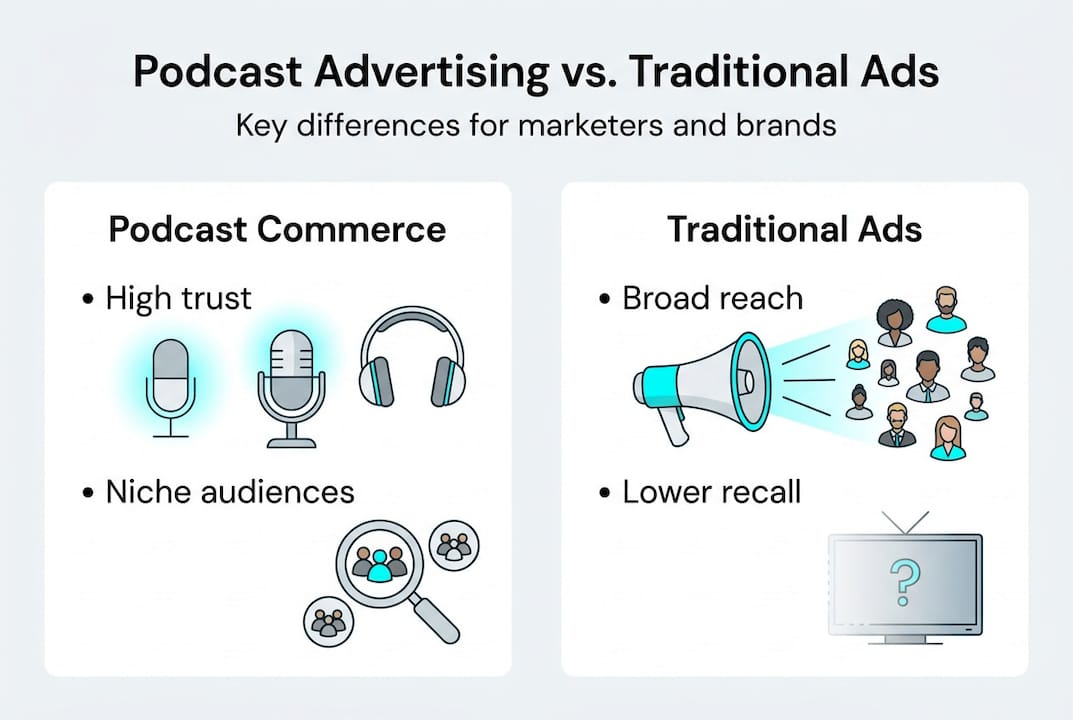
| Factor | Podcast Commerce | Traditional Digital Ads |
|---|---|---|
| Audience Intent | Active selection and subscription | Passive exposure |
| Trust Level | High (host endorsement) | Low (interruptive) |
| Brand Recall | 2.5x to 71% higher | Baseline |
| Action Rate | 78% take action | Significantly lower |
| CPM Range | $18-$50 | $2-$10 |
The economics work because podcast audiences are pre-qualified. They’ve already demonstrated interest in the topic. When you advertise on a fitness podcast, you’re reaching people actively thinking about fitness. When you sponsor a business show, you’re talking to entrepreneurs who are looking for solutions right now.
This creates a unique opportunity for podcast advertising effectiveness that goes beyond simple impressions. You’re entering conversations that matter to your exact target audience.
Core podcast commerce strategies for marketers
Building a podcast commerce strategy requires more than buying ad spots. Here’s how to approach it systematically.
1. Advertise on niche shows matched to your audience
Start by identifying podcasts where your ideal customers already spend time. Use directories like Listen Notes or AdvertiseCast to find shows that align with your buyer persona. The tighter the match, the better your results.
Host-read ads work best here. They carry the trust and authenticity that make podcast advertising so effective. Work with hosts who genuinely connect with your product.
2. Launch your own branded podcast
Creating your own show gives you complete control over the narrative. Interview formats work particularly well because they position your brand as a knowledge hub while featuring experts your audience wants to hear from.
Optimize your show notes for SEO. Audio content is powerful, but searchable text expands your reach beyond the podcast platforms themselves.
Distribute everywhere. 31% of branded podcast listening happens on Spotify, while 20% occurs on YouTube. Multi-platform distribution isn’t optional anymore.
3. Use podcast directories for targeted placement
Podcast directories function as discovery engines. They help listeners find shows and help advertisers find audiences. Leverage them for both.
4. Build episode-specific funnels
Every episode should have a clear call to action with a unique promo code or URL. This creates attribution and lets you track which episodes drive actual conversions.
Pro Tip: Create landing pages specific to each podcast campaign. When listeners visit, they should see messaging that matches what they just heard, creating a seamless experience from audio to action.
The power of podcast as a marketing channel comes from this integration. You’re not just broadcasting. You’re building pathways from discovery to purchase.
Comparing host-read versus programmatic podcast advertising
Choosing between host-read and programmatic ads isn’t about picking a winner. It’s about understanding what each format delivers.
Host-read ads bring trust and personalization. When a host talks about your product in their own words, it carries weight. The 2.5x to 71% higher brand recall isn’t accidental. It’s the result of authentic endorsement.
These ads cost more and require relationship building with hosts. You’re paying for their credibility and their ability to integrate your message naturally into their content.
Programmatic ads offer scale and automation. You can reach thousands of podcasts instantly, targeting by category, demographics, or listener behavior. The trade-off is personalization. Programmatic spots are pre-recorded and inserted dynamically, so they lack the host’s voice and context.
Ad Format Comparison
| Feature | Host-Read | Programmatic |
|---|---|---|
| Trust Factor | Very High | Moderate |
| Brand Recall | 2.5x-71% higher | Baseline |
| Scalability | Limited | High |
| Cost | Higher | Lower |
| Personalization | Maximum | Minimal |
| Setup Time | Longer | Immediate |
The strongest strategies blend both approaches. Use host-read ads for your core target shows where deep engagement matters. Deploy programmatic for broader reach and testing new audience segments.
Pro Tip: Start with a small batch of host-read campaigns to establish your messaging and understand what resonates. Once you’ve validated your approach, scale with programmatic to expand reach while maintaining those high-value host relationships.
Data-driven podcast advertising means testing both formats and letting performance guide your budget allocation.
Turning podcasts into a product discovery engine
Podcast commerce goes beyond advertising. The content itself can drive discovery when you structure it intentionally.
Align your podcast themes with buyer interests and evergreen questions. If you sell productivity tools, create episodes about time management, focus techniques, and workflow optimization. Your product becomes the natural solution to problems you’re helping listeners solve.
Leverage show notes strategically. These aren’t just episode summaries. They’re SEO-optimized landing pages that help non-listeners discover your content through search. Include product links, key takeaways, and timestamps for easy navigation.
Create shareable clips and highlights. Not everyone will listen to a full 45-minute episode, but a 90-second clip with a powerful insight can spread across social platforms and drive traffic back to your full content.
Feature guest experts who bring their own audiences. When you interview someone with an established following, you tap into their network while providing value to your existing listeners.
The action rate matters here too. Remember that 78% of listeners take action after hearing podcast content. When your show provides genuine value and naturally integrates product mentions, you’re not interrupting. You’re helping.
Platform Distribution Strategy
| Platform | Listener Share | Best For |
|---|---|---|
| Spotify | 31% | Music-focused audiences |
| YouTube | 20% | Video podcast content |
| Apple Podcasts | 25% | iOS users |
| Other Platforms | 24% | Niche audiences |
Distribution across multiple platforms isn’t just about reach. Different platforms serve different discovery behaviors. YouTube listeners often find podcasts through search and recommendations. Spotify users discover through playlists and algorithmic suggestions. Apple Podcasts still dominates for dedicated podcast apps.
Implementing podcast SEO best practices ensures your content gets found regardless of where your audience starts their search.
Measuring, optimizing, and scaling podcast commerce campaigns
Tracking podcast ROI requires specific attribution methods because audio doesn’t offer click-through rates or pixel tracking.
1. Use unique promo codes and URLs
Every campaign needs its own identifier. Promo codes work well for direct purchases. Vanity URLs help track website visits and downstream conversions. Both give you clear attribution to specific podcasts or episodes.
2. Track the metrics that matter
Downloads are vanity metrics. Focus on brand lift, conversion rate, customer acquisition cost, and audience growth instead. These numbers tell you whether your podcast commerce strategy actually drives business results.
3. Test creative messaging and calls to action
Run A/B tests on your ad copy, offer structure, and CTA placement. Small changes in how you frame your message can significantly impact conversion rates.
4. Analyze performance by platform
Not all podcast platforms convert equally. Track which ones drive the most valuable actions and adjust your distribution and advertising spend accordingly.
5. Iterate based on actual results
The 78% action rate and $18-$50 CPM range are industry benchmarks, but your specific results will vary. Use your own data to refine targeting, messaging, and budget allocation.
Pro Tip: Create a simple dashboard that tracks promo code usage, URL visits, and conversion rates by podcast. Review it weekly during the first month of any campaign, then monthly once you’ve established baseline performance.
Measuring podcast ROI becomes straightforward when you build attribution into your campaigns from the start. Don’t wait until after launch to figure out how you’ll track success.
For campaigns using video podcasts on YouTube, dynamic ad insertion offers additional flexibility for testing and optimization without re-uploading content.
Bring your podcast commerce strategy to life with Prodcast
You’ve got the strategies. Now you need the tools to execute them.
Prodcast turns podcast content into actionable commerce intelligence. Instead of manually scrubbing through hours of audio to find product mentions or key moments, our AI analyzes transcripts across thousands of shows to surface exactly what your audience is hearing and caring about.

Want to know which productivity tools entrepreneurs are actually recommending this month? Which skincare brands beauty podcasters can’t stop talking about? What AI tools are trending across tech shows? Prodcast gives you those insights in real time, helping you identify partnership opportunities, validate product-market fit, and discover what’s resonating before your competitors do.
For marketers running campaigns, this means smarter targeting. You can see which podcasts are already discussing topics adjacent to your product, making them ideal advertising partners. You can track how often your brand gets mentioned organically and measure share of voice against competitors.
Explore podcast moments to discover the exact clips and conversations driving product discovery right now. Or dive into specific shows like Mass Persuasion to see how top podcasters integrate commerce naturally into their content.
Podcast commerce works when you have the data to make smart decisions. Prodcast gives you that data.
Frequently asked questions
What is the average cost of podcast advertising for commerce campaigns?
Podcast advertising CPMs range from $18 to $50, with ROI driven by listener engagement and precise campaign targeting rather than raw impression volume.
How do I measure the effectiveness of my podcast commerce ads?
Use unique promo codes and vanity URLs for each campaign, then track conversion rates and brand lift. The 78% listener action rate provides a benchmark for evaluating your performance.
Are host-read ads better than programmatic ads for ROI?
Host-read ads typically deliver superior results, with 2.5x to 71% higher brand recall compared to programmatic formats, though the best strategies often combine both approaches.
Should I start my own branded podcast or advertise on existing shows?
Both methodologies work effectively. Advertising on niche shows provides immediate targeted reach, while launching a branded podcast builds long-term audience trust and positions your brand as a knowledge authority.