CATEGORIES
TAGS
How podcasts inspire change: strategies for marketers

TL;DR:
- Podcasts build trust and influence cognitive, emotional, and behavioral outcomes more effectively than other channels.
- Effective podcast marketing relies on content fit, host trust, retention, and precise attribution methods.
- Podcast impact extends beyond sales to social change and trend identification, requiring rigorous measurement.
Over two-thirds of podcast listeners made a purchase based on a host’s recommendation, and 84% report that podcasts genuinely shifted their beliefs. That’s not passive entertainment. That’s influence at scale. Yet most marketers still treat podcasts like digital billboards, measuring success in downloads and impressions while missing the real story buried inside the audio. This guide breaks down why podcasts are uniquely powerful at driving change, how the persuasion mechanism actually works, and what you can do right now to capture and act on that influence before your competitors do.
Table of Contents
- Why podcasts are more persuasive than other channels
- The mechanism stack: how podcasts translate influence into action
- Podcast-driven change: beyond consumer action to advocacy and trends
- Best practices: measuring and maximizing podcast-inspired change
- Our take: the uncomfortable truth about measuring podcast impact
- Amplify your podcast’s influence with Prodcast
- Frequently asked questions
Key Takeaways
| Point | Details |
|---|---|
| Podcasts drive real action | Host recommendations and engaged content prompt purchases and changed beliefs, not just awareness. |
| Trust amplifies persuasion | Deep listener trust in podcast hosts makes messages and CTAs more effective than traditional ads. |
| Advocacy goes beyond sales | Podcasts inspire not only product discovery but also activism and institutional change. |
| Measure what matters | Track retention, intent, and attribution data for a true view of podcast impact, not just downloads. |
| Study trends with podcasts | Use podcasts strategically to uncover emerging product and consumer trends ahead of competitors. |
Why podcasts are more persuasive than other channels
Let’s be honest. Most marketing channels are fighting for scraps of attention. Social media feeds are noisy. Banner ads get ignored. Email open rates are dropping. Podcasts, though? People listen while commuting, exercising, cooking. They give podcasts the kind of focused attention that almost no other channel gets anymore.
That attention is the foundation. But attention alone doesn’t explain why podcasts change minds and wallets. The real reason is trust.
When a host recommends something, it doesn’t feel like an ad. It feels like advice from a friend who happens to know a lot about the topic. That parasocial bond, the feeling of knowing someone through their voice alone, is surprisingly powerful. Listeners learn the host’s opinions, sense of humor, and values over dozens of episodes. By the time the host mentions a supplement brand or a productivity app, the listener is already primed to care.
Research backs this up. Podcasts measurably influence cognitive, emotional, and behavioral outcomes in listeners, making them one of the most complete persuasion tools in the modern media landscape. That three-layer influence is rare. Most channels hit one or two layers. Podcasts routinely hit all three.
Here’s what that looks like in practice:
- Cognitive impact: Listeners learn about products, trends, and ideas they’d never searched for. A fitness podcast mentions a cold plunge protocol, and suddenly 10,000 listeners are Googling cold therapy equipment.
- Emotional impact: The host’s enthusiasm or personal story creates genuine emotional resonance. When someone shares how a product changed their life, listeners feel it.
- Behavioral impact: That emotional resonance converts. Listeners buy, subscribe, share, advocate, and change habits because of what they heard.
Using a podcast as a marketing channel isn’t just about reach. It’s about creating the kind of deep, trust-fueled influence that other channels can only approximate.
“Podcasts represent a uniquely intimate form of mass communication. The voice creates closeness. The closeness creates trust. The trust creates action.”
Pro Tip: If you’re a marketer deciding where to place your next campaign, ask yourself whether your chosen channel builds trust over time or just borrows it in a 30-second window. Podcasts build it. Almost nothing else does at scale.
The mechanism stack: how podcasts translate influence into action
Understanding why podcasts are persuasive is one thing. Understanding how that persuasion flows into measurable outcomes is where the real strategic value lives.
Think of it as a mechanism stack with three layers working together.
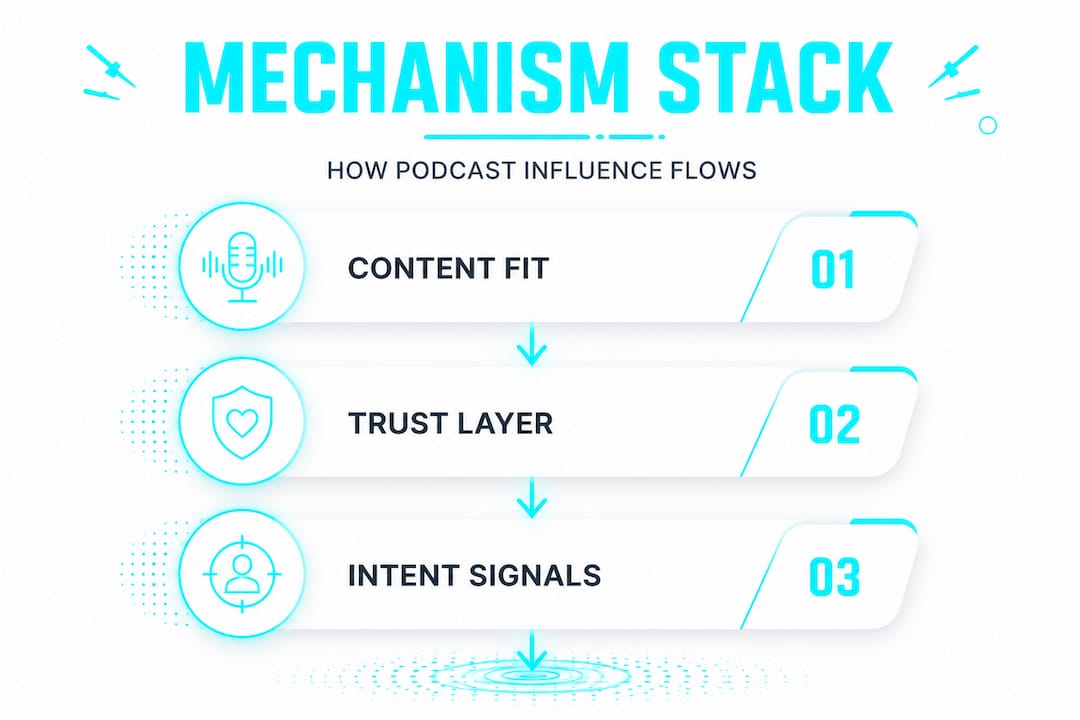
Layer 1: Content fit. The host’s topic, tone, and audience have to align with what you’re trying to communicate. A sleep supplement sponsor on a true crime podcast is a mismatch. The same sponsor on a wellness podcast becomes a natural part of the conversation. When content fits, recommendations land.
Layer 2: Host-listener trust. This is the layer most marketers underestimate. Host recommendations drive direct purchase behavior not because of clever ad copy, but because listeners have already decided to trust the host’s judgment. That trust is built over months or years before you even place your first campaign.
Layer 3: Intent signals and retention. Downloads tell you how many people started listening. Intent signals tell you how many people cared. Time spent, replays of specific segments, and promo code redemptions are the real indicators of whether your message landed.
Here’s a quick framework to help you see how these layers interact in practice:
| Mechanism | Example | Practical application |
|---|---|---|
| Content fit | Wellness host recommends magnesium for sleep | Partner with shows whose audience already searches for your category |
| Host-listener trust | Personal story of using a productivity app | Invest in long-form host-read ads, not pre-recorded spots |
| Retention and intent | High replay rate on a product recommendation segment | Track segment-level retention, not just episode downloads |
| Promo code attribution | Listener uses “PODCODE” at checkout | Assign unique codes per show to measure direct conversion |
| Social amplification | Listener shares the episode clip recommending a book | Monitor mentions and shares as an intent signal proxy |
Building a genuine data-driven podcast marketing strategy means moving past vanity metrics and leaning into these mechanism layers.
Here’s a simple numbered approach to start doing that:
- Map content fit first. Before any deal, analyze what a show actually discusses, not just its topic category. Use transcript analysis to identify recurring product types, brand mentions, and audience interest signals.
- Negotiate host-read integrations. Pre-recorded spots have their place, but host-read ads outperform them on trust and conversion, especially in niche communities.
- Set up attribution before launch. Unique URLs, promo codes, and pixel-based attribution should be live before the episode drops, not scrambled together afterward.
- Measure retention at the segment level. Look at where listeners drop off and where they replay. Recommendations buried at the 58-minute mark of a 60-minute episode get fewer ears than those at the midpoint.
- Track longitudinal signals. One episode rarely moves the needle alone. Track behavior across 30, 60, and 90 days to see compounding effects.
Pro Tip: The best-performing podcast campaigns treat the host like a co-creator, not a media buy. Brief them on your product’s real story and let them tell it in their own voice. That authenticity is the actual product.
Podcast-driven change: beyond consumer action to advocacy and trends
Here’s where it gets really interesting. Most marketers are focused on sales attribution. But podcast influence doesn’t stop at the checkout page. It moves into social behavior, institutional action, and trend formation in ways that are genuinely surprising.
Consider the advocacy angle. There are documented cases where podcast campaigns shifted institutional positions. Medical students used podcasting as a persuasion tool to change a policy statement from a major professional organization. That’s not a consumer buying a blender. That’s a medium driving organizational change because the argument was structured, accessible, and trusted.
For marketers, this opens a different kind of campaign possibility: thought leadership and advocacy positioning. If your brand stands for something specific, a podcast series built around that position can shift how an entire audience thinks about a category, not just whether they buy your product.
Podcasts also function as powerful data-driven podcast product discovery engines. Researchers and strategists are increasingly using podcast content as a real-time signal for emerging trends. When multiple shows in a category start mentioning the same brand, ingredient, or concept within weeks of each other, that’s a leading indicator worth paying attention to.
Podcasting as a research method gives researchers and marketers a window into authentic consumer language, real product opinions, and genuine market sentiment, all before it shows up in traditional data sources.
Here’s how podcast-driven change actually breaks down across different action types:
| Action type | What it looks like | How to measure it |
|---|---|---|
| Purchase | Listener buys product after host recommendation | Promo code, UTM tracking, attribution windows |
| Advocacy | Listener shares or recommends the episode | Social listening, share tracking, community mentions |
| Belief shift | Listener changes opinion on a topic or category | Pre/post surveys, brand sentiment analysis |
| Social mobilization | Community takes collective action around a cause | Petition signatures, event attendance, hashtag tracking |
| Trend identification | A product or topic repeatedly surfaces across shows | Cross-podcast transcript analysis, mention frequency |
Key things podcasts do particularly well when it comes to broader change:
- Surface niche products before they hit mainstream awareness, giving early-mover brands a real edge
- Create shared vocabulary and frameworks around topics, shaping how audiences think and talk about categories
- Build sustained narrative over episodes, which compounds influence in a way a single ad never can
- Generate authentic peer-level discussion in listener communities that extends the original content’s reach
“Podcasts are how ideas travel. When the same idea shows up on three shows you trust in one week, you don’t question it. You act on it.”
That compounding effect is exactly why transcript analysis across thousands of episodes is such a valuable signal layer for marketers who want to stay ahead of trends.
Best practices: measuring and maximizing podcast-inspired change
So you’re convinced podcasts can drive real change. Now the hard part: proving it to your stakeholders and optimizing for it over time.
The honest reality is that podcast impact is often self-reported, meaning listeners say something changed their mind or drove a purchase, but connecting that to specific episodes or moments requires deliberate measurement infrastructure. Most marketers skip that infrastructure and then wonder why they can’t demonstrate ROI.
Here’s what serious measurement looks like:
- Start with attribution architecture. Every podcast placement needs a unique promo code, vanity URL, or trackable link. This is table stakes. Without it, you’re flying blind.
- Layer in pixel-based attribution. For brands with enough traffic, pixel attribution can catch listeners who heard an episode, didn’t use a code, but converted later. This closes a significant gap.
- Track retention at the episode and segment level. Most podcast hosting platforms offer this data. Use it. Segments with high retention and high replay rates are your most persuasive moments.
- Run pre and post brand lift surveys. For larger campaigns, measure awareness, consideration, and intent before and after the campaign window. This captures belief shift, not just purchase behavior.
- Monitor social and community signals. Reddit threads, Facebook group discussions, and Twitter mentions that reference a podcast episode are gold. They show organic amplification and belief-level engagement.
- Build a 90-day attribution window. Podcast influence is slow-burning. Someone who heard an episode today might convert in six weeks. Short attribution windows systematically undercount podcast ROI.
A quick stat worth bookmarking: Marketers who use triangulated attribution (combining promo codes, pixel tracking, and brand lift surveys) report 2 to 3 times more accurate ROI attribution than those relying on a single data source alone.
Smart podcast metric selection is the difference between a channel that looks unremarkable and one that clearly moves your business.
Pro Tip: Build your measurement stack before the campaign launches, not after. Attribution infrastructure is almost impossible to retrofit cleanly. If you can’t track it, you can’t prove it, and you can’t scale it.
Our take: the uncomfortable truth about measuring podcast impact
Here’s something the industry doesn’t say often enough: most podcast impact claims are not as solid as they look.
When a host says “we drove thousands of sales last quarter,” that number is almost always sourced from promo code redemptions alone. That captures maybe 30 to 40 percent of actual conversions, because many listeners convert through branded search, direct navigation, or delayed clicks that never get tied back to the episode. The real number is almost always bigger. But the measurement is sloppy.
And vanity metrics make this worse. Downloads are the most overused data point in podcasting. A show with 200,000 monthly downloads sounds impressive until you realize that many of those are background listeners who aren’t engaged at the point of the recommendation. Completion rate, segment retention, and intent signals tell a much more honest story.
What experienced marketers do differently is they build attribution in from day one, run longitudinal cohort analysis to see how podcast-exposed audiences behave over time, and treat the host relationship as an ongoing partnership rather than a transactional media placement.
Real-world podcast product discovery happens when you layer structured data on top of authentic audio content. The combination of trust-driven host influence and rigorous measurement is what separates campaigns that generate buzz from campaigns that generate revenue.
The self-reported nature of podcast effects is a real limitation. Acknowledge it, triangulate around it, and you’ll make better decisions than 90 percent of marketers in this space.
The bottom line? Stop measuring podcasts like you measure display ads. They’re not the same animal. Podcasts are a relationship medium. Measure them like one.
Amplify your podcast’s influence with Prodcast
You now know why podcasts drive change, how the mechanism works, and what measurement actually looks like when it’s done well. The next step is having the right tools to act on those insights at scale.

Prodcast is built exactly for this. Our AI analyzes podcast transcripts across thousands of shows to surface the product mentions, brand discussions, and influential moments that matter most to your category. Instead of manually scrubbing hours of audio, you get structured, searchable data that tells you what audiences are actually hearing and caring about right now. Whether you want to discover influential podcast moments in your niche or dig into persuasion patterns by exploring mass persuasion episodes, Prodcast gives you the signal layer that most marketers are still missing. Start turning audio conversations into actionable strategy today.
Frequently asked questions
How do podcasts actually change listener behavior?
Podcasts enhance cognitive, emotional, and behavioral outcomes by building host-listener trust and delivering persuasive messages through authentic, long-form content that other channels can’t replicate.
Do podcast ads really drive product sales?
Yes. 67% of listeners made a purchase from a host recommendation, making podcast advertising one of the highest-converting formats in digital marketing when attribution is set up correctly.
What metrics should I use to measure podcast impact?
Go beyond downloads and use retention, intent signals, and conversion data alongside proper attribution tracking. Triangulating with behavioral proxies gives you a far more accurate picture than any single metric alone.
Can podcasts generate social or cultural change?
Absolutely. Medical students used podcasting to successfully shift a policy statement from a major professional organization, demonstrating that podcast influence extends well beyond consumer purchasing behavior.
How do podcasts reveal product trends?
Podcasting as a research method lets marketers track emerging product mentions and shifting consumer language across shows before those trends appear in mainstream data sources, giving early-mover brands a genuine edge.
Recommended
- How podcasts drive sales: data-backed strategies for mark… | Prodcast
- How podcasts drive sales: data-backed strategies for mark… | Prodcast
- Why podcasts matter for brands: drive engagement and trust | Prodcast
- Why podcasts matter for brands: drive engagement and trust | Prodcast
- How to build real campaign momentum with data